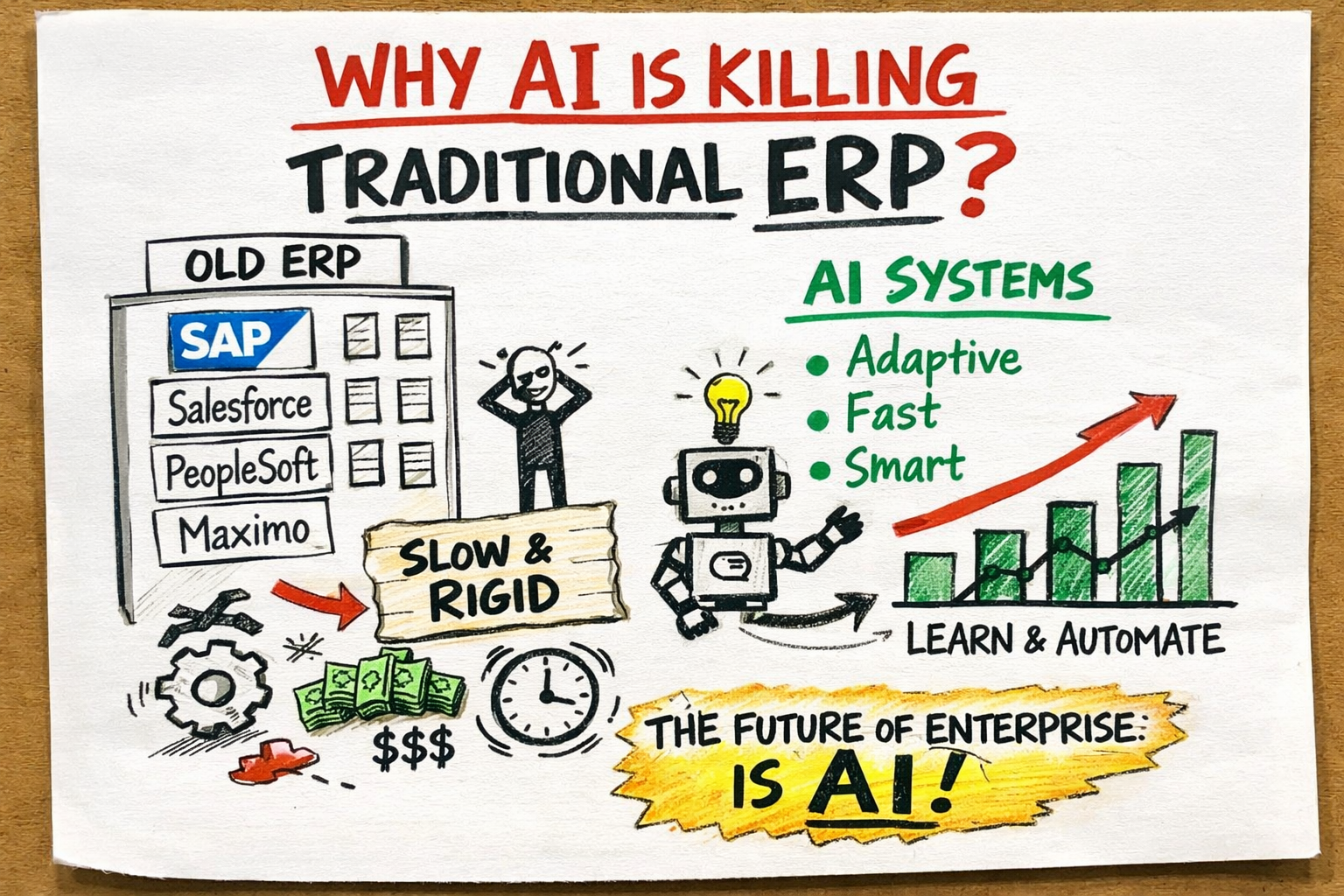
For decades, companies spentmillions implementing ERP systems like SAP, Salesforce, PeopleSoft, and Maximobelieving they would solve operational problems.
But many organizations are discovering a painful reality:ERP systems often adapt slower than the business itself.
Today,AI-powered systems are transforming enterprise operations, shifting from rigid software frameworks toadaptive, intelligent operational platformsthat learn and evolve with the business.
This article explains why thefuture of enterprise software will be AI-native systems, not traditional ERP platforms.
Why AI Is Quietly Killing Traditional ERP Systems
For the last30 years, enterprise software dominated how companies run operations.
If a company wanted to digitize operations, the solution was almost always the same:
- ImplementSAP
- DeploySalesforce
- IntegratePeopleSoft
- InstallMaximo
Consultants would arrive. Budgets would explode. Implementations would take12–36 months.
And leadership believed the system would finally bring operational efficiency.
But something strange happened.
Despite billions invested in ERP technology, many companies still struggle with:
• Slow decision making
• Data fragmentation
• Complex workflows
• Endless customization cycles
• Rising operational costs
The software that promised efficiency often becameanother operational burden.
The Real Problem with Traditional ERP
Traditional ERP systems were built on one core assumption:
Your business must adapt to the software.
But modern businesses don’t work that way anymore.
Markets move faster. Customer expectations evolve constantly. Operational complexity grows every year.
Yet ERP systems remain:
- Rigid
- Expensive
- Slow to change
- Dependent on consultants
In many organizations today, teams spend more timemaintaining the system than improving the business.
And the worst part?
Every customization introduces new complexity.
Where AI Changes Everything
AI introduces something enterprise software has never truly had:
Adaptive Intelligence.
Instead of forcing businesses to operate inside predefined modules, AI systems can:
• Learn operational patterns
• Analyze workflow bottlenecks
• Predict business outcomes
• Automate repetitive decision processes
• Continuously improve operational efficiency
This means the software evolveswith the business, not behind it.
ERP vs AI-Powered Business Platforms
Traditional ERP systems were designed torecord business activity.
AI systems are designed tounderstand business activity.
The difference is massive.
ERP systems answer:“What happened?”
AI systems answer:“What will happen next, and what should we do?”
That shift changes how organizations operate.
Why Large ERP Vendors Are Struggling
Companies like SAP and Salesforce face a difficult structural problem.
Their platforms are built on:
- Legacy architectures
- Large consulting ecosystems
- Complex implementation models
But AI reduces complexity instead of increasing it.
Which means the traditional enterprise software business model is under pressure.
The future is not aboutbigger software suites.
It is aboutsmarter operational intelligence layers.
The Next Generation of Enterprise Systems
The next wave of enterprise platforms will beAI-native operating systems for businesses.
Instead of static dashboards, these systems will:
• Monitor operational data in real time • Predict risks and opportunities • Recommend operational decisions • Automate complex workflows • Learn continuously from business activity
This transforms software froma reporting toolintoa decision engine.
The Bottom Line
Companies are starting to realize something critical.
Buying larger enterprise softwaredoes not automatically solve operational problems.
Understanding how the business operates — and buildingintelligent systems around it— does.
AI is not simply improving enterprise software.
It is redefining how businesses run.
And the organizations that embrace this shift will operate faster, smarter, and far more competitively than those trapped inside traditional ERP ecosystems.
💡The future of enterprise technology will not be bigger ERP systems.
It will beAI-powered operational intelligence.
Originally published on a2cybertech.blogspot.com.
Building something similar?
Turn this into a production VoIP, PBX, AI voice or SaaS architecture.
Discuss Your Project