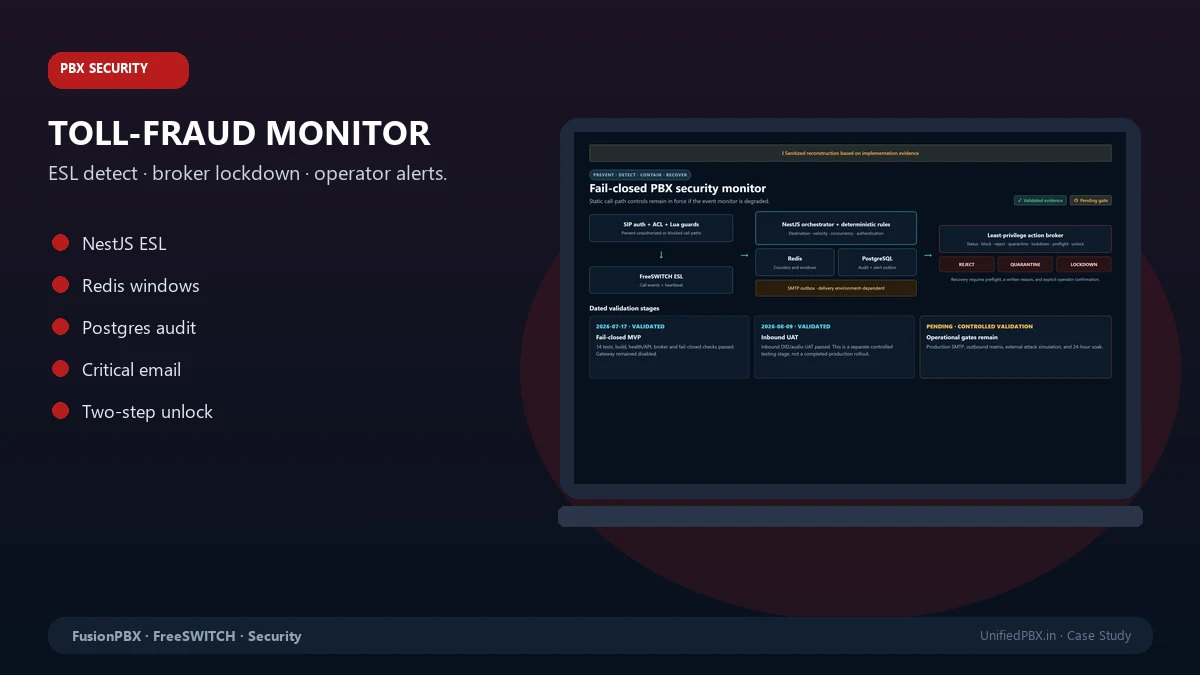
Scenario: Finance forwards a carrier invoice with unfamiliar international destinations. CDRs show hundreds of short outbound calls between 02:00 and 05:00 local time. The FusionPBX dashboard still shows trunks “registered.” The wrong move is installing a random script from a forum and re-enabling outbound routes without understanding what was compromised.
Direct answer
First 15 minutes (approved by your incident lead):
- Carrier — report suspected fraud, ask whether outbound can be restricted or suspended on their side; get a ticket reference.
- Contain — disable or narrow affected outbound routes, rotate exposed credentials, or ACL-block known bad destinations using your change process (not ad-hoc edits without backup).
- Preserve — export CDRs, FreeSWITCH logs, and authentication events before log rotation; note timezone and server clock.
A monitoring product helps after you survive the hour: pattern detection, incidents, alerts, gated unlock. It does not replace carrier response. See FusionPBX & FreeSWITCH Security Monitor and the case study.
Incident lifecycle
Detect → Investigate → Contain → Remediate → Validate → Recover| Phase | Goal | Common mistake |
|---|---|---|
| Detect | Know within minutes, not at invoice | No baseline for “normal” outbound |
| Investigate | Tie calls to credential, route, or dialplan | Blaming “the internet” without CDR join |
| Contain | Stop bleeding | Blocking all inbound to “fix” outbound |
| Remediate | Patch creds, dialplan, ACL | Reusing same SIP password |
| Validate | Test inbound and outbound | Clearing lockdown = carrier restored (they are different) |
| Recover | Document thresholds and runbooks | Re-enabling full international without caps |
What to collect (evidence pack)
- CDRs — source extension/user, destination, duration, disposition, trunk, timestamp (UTC normalized).
- FreeSWITCH logs —
sofiaregistration failures/successes, dialplan execution, bridge outcomes. - Auth events — failed REGISTER bursts from new IPs (may be scanning, not the same as toll fraud).
- Destination patterns — country codes, premium ranges, sequential dialing.
- Config snapshot — outbound routes, dialplan contexts, user directory after containment (for diff).
Store read-only; restrict access; define retention with legal/compliance if recordings exist.
Detection examples (synthetic thresholds)
Illustrative rules only—tune per carrier, business hours, and legitimate dialer campaigns:
| Signal | Example threshold | False-positive risk |
|---|---|---|
| Outbound calls per minute per account | > 10 sustained 2 min | Call-back campaigns, power dialers |
| Concurrent outbound channels | > N vs historical P95 | Monday morning spikes |
| New country mix | first-time premium prefix burst | Travel, new market test |
| Short-duration international | many < 6s to same range | misconfigured IVR loop |
| Failed REGISTER storm | > 50/min from one IP | internet background noise |
Test thresholds in alert-only mode before auto-containment. The monitor product documents velocity/concurrency/distinct-destination windows on outbound channel events—confirm signals for your deployment.
Example timeline (synthetic, labeled)
| Time (UTC) | Event |
|---|---|
| 02:14 | Outbound CPS to +88x exceeds baseline × 8 |
| 02:16 | Alert email: incident opened |
| 02:22 | Operator disables international route on trunk T1 |
| 02:40 | CDR export attached to incident |
| 03:10 | Credential rotation on extension 4xx range |
| 08:00 | Validation: inbound IVR OK; outbound domestic test OK |
| 08:30 | Carrier confirms fraud block; separate approval to restore intl route |
Unlock ≠ carrier billing restored
In the documented monitor design, clearing security lockdown does not automatically re-enable carrier billing or outbound routes. Operators verify root cause addressed, test inbound, then follow a gated procedure for carrier/trunk restoration. See product FAQ and case study unlock API.
Monitoring gaps to plan for
- ESL or event collector down → blind spot while PBX still calls.
- Disk full → log loss before investigation.
- Alert email to unmonitored mailbox.
- False positives on legitimate outbound campaigns → alert fatigue → rules disabled.
Prevention still requires strong SIP passwords, ACLs, dialplan guards, patching, and least privilege—security & reliability, production rescue.
Engagement types
| Situation | Start here |
|---|---|
| Active fraud / bill shock | Incident triage + evidence |
| No incident | Assessment + gap review |
| Ready to instrument | Monitor deployment + UAT |
| Many instances | Per-instance boundaries |
False positives and legitimate traffic
Legitimate patterns that trip naive rules:
- Outbound reminder campaigns — high CPS for minutes, domestic only.
- International sales desks — new country mix after marketing launch.
- Call-back queues — many short outbound legs to returned missed calls.
- Conference bridges — concurrent channels without long duration.
Mitigation: allowlists per trunk, business-hours windows, per-extension roles, manual approval for auto-contain, and separate rules for inbound vs outbound. The case study documents inbound UAT after tightening outbound rules—retest both directions.
Safe recovery checklist
- Root cause documented (credential leak, open route, weak IVR forward)
- Affected passwords rotated; old credentials invalidated at carrier if supported
- Dialplan diff reviewed; unexpected
transfer/bridgepaths removed - Inbound IVR and main DID tested per site
- Outbound domestic test call; then international if required—with spend cap
- Monitor/alert paths healthy (not the same mailbox that missed the first alert)
- Carrier fraud ticket closed or escalated with reference
When to choose triage vs full monitor deployment
Triage when bills or CDRs already prove an incident—you need containment forensics this week. Assessment when leadership asks “are we exposed?” without active fraud. Deployment when ESL access, alert owners and unlock procedures are ready—instrumentation without runbooks creates false confidence.
Author note: Engineering evidence and limitations are on the FusionPBX security monitor case study—not marketing claims.
Limitations: No product guarantees all fraud prevented; attacker behavior and misconfiguration vary. We do not publish invented savings figures.
Next step: Assess my PBX security · Earlier narrative incident