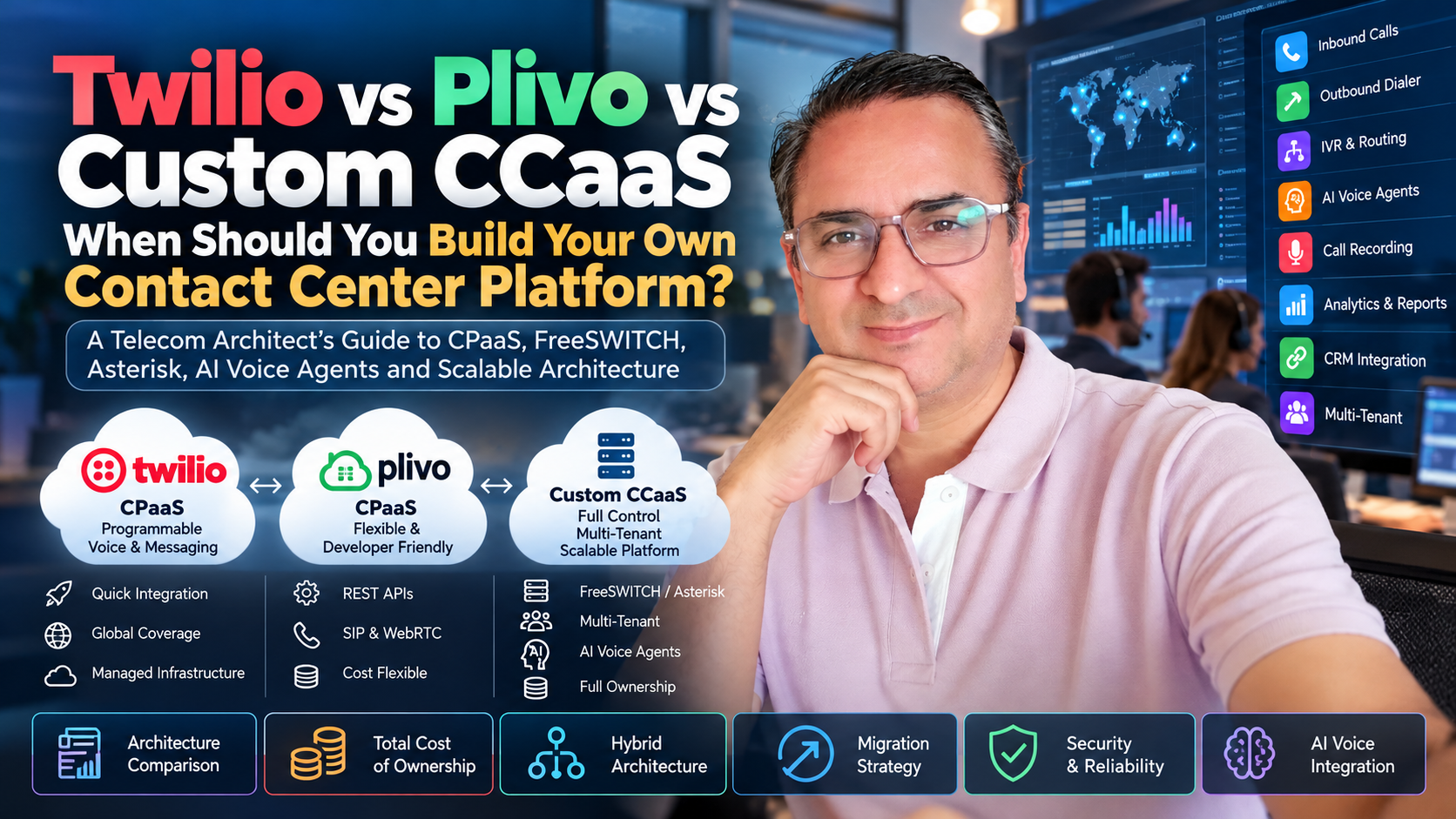
A Telecom Architect’s Guide to CPaaS Economics, FreeSWITCH, Asterisk, AI Voice Agents, and Scalable Contact Center Architecture
Businesses rarely outgrow their communication platform overnight. It happens gradually: a few more agents, additional outbound campaigns, a CRM integration, more complex IVR flows, AI voice agents, recording and compliance requirements, and eventually a billing model that becomes harder to predict.
Initially, a cloud communications API may be all a business needs. But as the product evolves, a more important question emerges:
Should you continue building on Twilio or Plivo, introduce your own telephony infrastructure, or develop a custom CCaaS platform that combines both approaches?
This is not simply a comparison of voice API providers. It is a decision about software architecture, operational responsibility, product differentiation, cost structure, and long-term control over your communication infrastructure.
Having worked across VoIP, PBX systems, FreeSWITCH, Asterisk, telecom integrations, and full-stack SaaS architecture, I believe the right answer starts with understanding what the business is actually trying to own: a communication feature, a contact center product, or an entire telecom platform.
Let's examine the trade-offs from an architectural and business perspective.
1. The Real Difference Between CPaaS and CCaaS
Before comparing vendors, it is important to distinguish the categories.
CPaaS: Communication as a programmable capability
Communications Platform as a Service (CPaaS) provides APIs and services that developers can integrate into their own applications.
Examples include:
- Programmable inbound and outbound calling
- Phone number provisioning and voice routing
- SMS and other messaging capabilities
- WebRTC-based browser calling
- Call recording and audio streaming
- Speech recognition and AI integrations
- SIP connectivity and carrier integration
Twilio and Plivo are examples of providers offering programmable communications capabilities.
A business can use these services to embed calling into a CRM, sales application, appointment system, customer support workflow, or AI voice agent.
The application developer remains responsible for the business-specific experience and the surrounding software architecture.
CCaaS: A complete contact center operating environment
Contact Center as a Service (CCaaS) focuses on the operational requirements of customer communication.
Depending on the product, this may include:
- Agent and supervisor interfaces
- Inbound queues and outbound dialers
- IVR and intelligent call distribution
- Skills-based routing and business rules
- Agent availability and real-time monitoring
- Call recording, reporting, and analytics
- CRM integration and customer interaction history
- Quality assurance and performance management
- Billing, tenant administration, and access control
- AI-assisted customer interactions
A CPaaS API can be a building block for a CCaaS product, but it is not the same thing as the complete product.
The architectural distinction is simple: CPaaS supplies communication capabilities; CCaaS organizes those capabilities into a contact center operating model.
A company can build its CCaaS application on top of a CPaaS provider. It can also operate its own telephony infrastructure, or combine managed communications services with self-managed components.
These are architectural choices, not mutually exclusive product categories.
2. Twilio vs Plivo: What Are You Actually Buying?
The choice between Twilio and Plivo should not be reduced to which provider has the lowest advertised per-minute rate.
Both offer programmable voice capabilities, but the suitability of either provider depends on the application's requirements, geographic coverage, available features, commercial terms, and integration model.
Twilio: A programmable communications foundation
Twilio can be a suitable choice when a development team needs programmable calling and wants to integrate communications into an existing software product.
Typical use cases include:
- Click-to-call functionality in a CRM
- Automated appointment reminders
- Voice-enabled business applications
- Call recording and transcription workflows
- Browser-based calling
- Voice AI applications
- Integration with existing SIP infrastructure
The key advantage of a managed communications platform is that the application team can concentrate on business logic without having to operate every layer of the underlying telephony infrastructure.
However, the complete cost model must account for more than the base voice rate. Number rental, call routing, recording, transcription, AI features, SIP connectivity, media processing, and other services may contribute to the total.
Reference: Twilio Programmable Voice pricing.
Plivo: Another programmable voice option
Plivo is also worth evaluating for programmable voice applications, SIP-based integrations, and communication workflows.
Depending on the market and plan, relevant capabilities can include:
- Inbound and outbound calling
- Programmable voice APIs
- Browser and WebRTC calling
- SIP trunking
- Audio streaming
- Call recording and speech-related services
- Voice AI integration options
For an engineering team considering Plivo, the evaluation should cover the exact APIs, required features, supported routes, service limits, support arrangements, and commercial conditions for its target markets.
Reference: Plivo Voice API pricing for India.
How should you compare them?
| Evaluation criterion | What to investigate |
|---|---|
| Geographic coverage | Destinations, number availability, and local restrictions |
| Voice quality | Route quality, latency, packet loss, and jitter |
| API capabilities | Call control, webhooks, recording, and error handling |
| WebRTC | Browser support, media connectivity, and network traversal |
| Throughput | Calls per second and concurrent-call limits |
| Commercial model | Usage rates, number charges, add-ons, and volume agreements |
| Reliability | Status reporting, incident response, and operational support |
| Integration | CRM, SIP infrastructure, AI services, and existing applications |
| Portability | Number ownership, routing flexibility, and migration procedures |
There is no universally superior provider. A meaningful comparison requires a representative workload and a test environment.
For example, an application making appointment reminder calls has a different operational profile from an outbound sales dialer supporting hundreds of concurrent calls, agent monitoring, campaign pacing, and real-time reporting.
The second workload demands more than a successful API call. It requires coordinated call control, concurrency management, campaign state, event processing, and operational observability.
3. The Hidden Problem: Your Application Is Growing Faster Than Your Telephony Design
A business can begin with a simple architecture:
CRM → Backend API → Voice provider → Customer.
That architecture may work perfectly well in the early stages.
Then requirements expand.
The business introduces multiple tenants, multiple outbound campaigns, inbound queues, custom agent states, call recording policies, customer-specific routing, usage-based billing, and AI-powered call handling.
The application gradually acquires responsibilities that were not part of its original design.
For example:
- Which tenant owns a phone number?
- Which agent should receive an inbound call?
- How should concurrent campaigns share outbound capacity?
- How do we prevent duplicate processing of call-completion events?
- How should a failed webhook be retried?
- How do we reconcile provider usage with customer invoices?
- What happens when the CRM is unavailable but calls must continue?
- How can we switch providers without rewriting the entire application?
These are not merely API integration questions. They are platform architecture questions.
The mistake is assuming that adding more API endpoints will automatically solve the increasing complexity of a multi-tenant contact center.
A better approach is to separate the application's business capabilities from its underlying telephony implementation.
4. The Three Architecture Models
There are three practical models worth evaluating before committing to a platform strategy.
Model A: Fully managed CPaaS
Architecture
Customer or agent → Application backend → Twilio or Plivo → PSTN destination.
The provider manages the communications capabilities that are part of its service. Your application manages the customer experience, business rules, integrations, and any other responsibilities outside the provider's scope.
Best suited for:
- Early-stage products
- MVPs and proof-of-concept systems
- Low-to-moderate complexity voice applications
- Teams that want to minimize telephony operations
- Products where rapid delivery matters more than owning the voice infrastructure
Advantages
- Faster initial implementation
- Less infrastructure to operate
- Access to managed voice services
- Easier experimentation with new workflows
- Potentially lower operational burden for a small team
Trade-offs
- Ongoing dependence on the provider's commercial model
- Less control over provider-managed call handling
- Integration and portability work when changing vendors
- Additional complexity when product requirements extend beyond available abstractions
A managed CPaaS architecture can remain the right long-term decision. Growth alone is not a reason to abandon it.
Model B: Fully custom CCaaS with self-managed telephony
Architecture
Customer or agent → Custom CCaaS application → Telephony control layer → FreeSWITCH or Asterisk → SIP trunks and carriers.
The application can include tenant management, agent interfaces, routing, queues, IVR, dialers, reporting, recording workflows, billing, and integrations.
FreeSWITCH or Asterisk can provide core telephony capabilities, depending on the requirements and implementation.
Best suited for:
- Telecom SaaS providers
- Businesses building their own PBX or CCaaS product
- Organizations needing deep control over call flows
- Products with specialized routing or tenant requirements
- Teams that can support telecom infrastructure in production
Advantages
- Greater control over call handling and telephony configuration
- Ability to design a product around specific business workflows
- More flexibility in carrier selection and routing architecture
- Greater ownership of the application and service model
- Potential for differentiated features and commercial packaging
Trade-offs
- Infrastructure and operational engineering become your responsibility
- Production reliability requires monitoring, testing, and incident management
- SIP interoperability, NAT, RTP, codecs, and carrier behavior require specialist knowledge
- Security, scaling, upgrades, backups, and disaster recovery must be engineered
- Development and maintenance costs can be substantial
A custom platform is not automatically cheaper. It exchanges some managed-service dependence for engineering and operational responsibility.
Model C: Hybrid CPaaS and custom CCaaS
Architecture
Agent and customer interfaces → Custom CCaaS application → Telephony abstraction layer → Managed CPaaS and/or self-managed PBX → SIP trunks and carriers.
The application owns its business logic and can use different telephony backends where justified.
For example, one customer workflow may use a managed voice API, while another may use FreeSWITCH and a selected SIP carrier.
A hybrid design does not require every customer or call to use every provider. It creates the option to choose the appropriate backend for a defined workload.
Best suited for:
- Growing SaaS products
- Multi-tenant contact centers
- Existing systems that cannot be replaced immediately
- Businesses that want to migrate incrementally
- Products that need different capabilities across customers or regions
Advantages
- Incremental migration instead of a risky full replacement
- Flexibility to retain useful managed services
- Opportunity to compare costs using real workloads
- Separation of product business logic from provider-specific APIs
- More options for resilience and future platform evolution
Trade-offs
- More architectural decisions to manage
- Multiple integrations and monitoring paths
- Provider-specific differences must be normalized carefully
- Failover and migration require explicit design
- Operating two models can increase short-term complexity
For many established products, a hybrid approach is worth investigating before a complete rewrite.
The objective is not to maximize the number of technologies. It is to preserve useful capabilities while improving control over the parts of the system that create the greatest business or technical constraints.
5. A Reference Architecture for a Custom CCaaS Platform
A production-oriented CCaaS platform should be designed as a set of cooperating subsystems rather than a collection of unrelated APIs.
A representative architecture might contain the following layers.
Layer 1: User experience
- Agent desktop
- Supervisor dashboard
- Administrator console
- Customer or tenant portal
- WebRTC softphone
- Reporting and analytics interface
A React or Next.js frontend can support the web application, while the browser calling layer communicates with the selected voice infrastructure.
Layer 2: Application and domain services
- Tenant and user management
- Authentication and authorization
- Contact and CRM management
- Campaign management
- Queue and routing policies
- IVR configuration
- Agent state management
- Billing and subscription management
- Call reporting and recording metadata
A modular backend can implement these capabilities using Node.js and NestJS, or another suitable application framework.
The important design decision is to establish clear ownership of business state and avoid embedding the entire product's logic inside provider-specific webhooks or telephony configuration files.
Layer 3: Telephony abstraction
This layer translates the application's business-level commands into the operations supported by the selected telephony backend.
Examples include:
- Originate an outbound call
- Answer or reject an inbound call
- Transfer a call
- Join a queue
- Play an announcement
- Start or stop recording
- Retrieve call status
- Terminate a call
A normalized interface helps isolate the application from provider-specific implementation details.
However, abstraction should not erase meaningful differences between providers. Advanced features, media behavior, error codes, and call-state transitions may need capability checks or provider-specific extensions.
Layer 4: Telephony infrastructure
Possible components include:
- FreeSWITCH or Asterisk
- SIP trunks and carrier gateways
- RTP media handling
- WebRTC connectivity
- IVR and dialplan execution
- Recording and media services
- Call routing and bridging
FreeSWITCH and Asterisk are not interchangeable in every detail. The selection should be based on required features, integration effort, operational experience, and the intended product.
Layer 5: Data, events, and observability
A scalable platform also needs:
- PostgreSQL for transactional application data
- A message broker when asynchronous event processing requires one
- Durable handling of call events and webhook retries
- Usage reconciliation and billing records
- Metrics, logs, and distributed tracing
- Alerting for failed calls, abnormal hangups, and infrastructure degradation
- Retention and access policies for recordings and transcripts
Prometheus and Grafana can support metrics and operational dashboards. Event-driven components can help separate real-time call handling from reporting, billing, and downstream integrations.
The exact architecture should follow the workload. Not every deployment needs Kubernetes, a message broker, or dozens of microservices from day one.
The goal is operationally appropriate separation of responsibilities, not architectural complexity for its own sake.
6. The Cost Question: When Does Custom CCaaS Make Financial Sense?
This is where many comparisons become misleading.
A managed provider's per-minute rate is visible. The cost of operating a custom platform is distributed across infrastructure, development, support, and operations.
Comparing only the provider's voice rate with the cost of a SIP trunk produces an incomplete answer.
Calculate total cost of ownership
For a managed CPaaS solution, include:
- Inbound and outbound call charges
- Number rental
- Recording and storage
- Transcription and AI services
- WebRTC or media-related charges
- Application hosting
- Integration development
- Support and monitoring
- Any relevant enterprise commitments
For a custom CCaaS platform, include:
- SIP trunk and carrier charges
- Telephony servers and media infrastructure
- Cloud or colocation expenses
- Redundancy and disaster recovery
- Recording storage and retention
- Development and maintenance
- DevOps and telecom operations
- Security and compliance work
- Customer support and incident response
- Ongoing testing and compatibility management
A simplified monthly model is:
Managed CPaaS cost
Monthly provider charges + application hosting + engineering and support overhead.
Custom CCaaS cost
Carrier charges + infrastructure + engineering amortization + operations + support + risk-related costs.
Hybrid CCaaS cost
Managed service charges for selected workloads + custom infrastructure costs + integration and operational overhead.
These formulas are intentionally simplified. Actual cost models should use the pricing terms, traffic profile, and responsibilities of the specific deployment.
Model the cost per productive interaction
Total call minutes are not always the best unit of comparison.
For a sales contact center, consider the cost per connected customer interaction. For customer support, consider the cost per resolved case. For a SaaS provider, consider the cost per tenant or active agent alongside the cost per call minute.
A platform that has a lower infrastructure bill but produces more failed calls, longer handling times, or more operational incidents may be more expensive overall.
Use scenario-based break-even analysis
Build at least three scenarios:
- Current usage and current architecture.
- Expected growth over the next 12–24 months.
- A downside case with lower demand, migration costs, or unexpected operational overhead.
Then calculate the point at which the custom or hybrid option becomes financially attractive.
There is no universal call-volume threshold at which building your own CCaaS becomes cheaper. The result depends on provider rates, usage patterns, feature requirements, team costs, service levels, and how much engineering work is reusable.
A custom platform can make sense even without immediate voice-cost savings if it enables a differentiated product or a revenue model that a managed integration cannot adequately support.
Conversely, a managed CPaaS platform can remain more economical when its operational benefits outweigh the additional usage charges.
7. Voice AI Changes the Architecture Decision
Voice AI adds another dimension to the CPaaS-versus-custom-CCaaS discussion.
A traditional IVR can use fixed menus and predefined call-routing rules. An AI voice agent may need streaming audio, speech recognition, turn-taking, tool execution, interruption handling, and escalation to a human agent.
The architecture must coordinate several independent systems:
- Telephony and media transport.
- Speech recognition or a streaming speech model.
- Conversation orchestration.
- Business tools, APIs, and customer data.
- Text-to-speech or audio generation.
- Call transfer and human-agent handoff.
- Logging, consent, retention, and quality evaluation.
A managed voice AI service may accelerate development by providing parts of this stack. A custom system may offer greater control over orchestration, model selection, data handling, or integration with existing contact-center operations.
But custom development also introduces responsibility for real-time performance, interruptions, failed tool calls, fallback behavior, and reliable transfers.
The important question is not whether a platform supports AI. It is whether the voice AI system can operate reliably within the actual business workflow.
For example, an AI agent handling appointment scheduling has different requirements from an AI agent qualifying outbound sales leads or assisting a human support representative during a live call.
A robust architecture should define what happens when the model fails, the customer interrupts, a backend API times out, or the conversation needs to move to a human agent.
Voice AI should be treated as an operational subsystem, not simply an additional API endpoint.
8. Migration Strategy: Do Not Rewrite Everything at Once
A complete migration from a managed CPaaS architecture to custom CCaaS may be justified, but it should not be the default starting point.
A controlled migration can reduce risk.
Phase 1: Establish a baseline
Measure actual usage, call success rates, latency, routing behavior, billing, failure patterns, and operational effort.
Document existing provider dependencies and identify which components create the most significant limitations.
Phase 2: Introduce a telephony adapter
Separate application-level commands from provider-specific API calls.
For example, the application can issue a business-level command such as originateCall, while a backend adapter implements the operation for the selected provider.
Define a consistent internal event model for call initiation, ringing, answer, completion, failure, and transfer. Preserve provider-specific metadata for troubleshooting.
Phase 3: Select a contained pilot workload
Choose a use case with measurable outcomes and limited operational risk.
A pilot might cover a defined outbound campaign, a test tenant, a particular routing workflow, or a controlled set of inbound calls.
Avoid sending live traffic through a new backend until the critical call flows, failure handling, monitoring, and rollback procedures have been tested.
Phase 4: Validate production behavior
Test more than whether a call connects.
Validate:
- SIP signaling and authentication
- Early media and announcement behavior
- RTP connectivity, codecs, and network traversal
- Answer detection and call progress
- Transfers, bridges, and hangup handling
- Recording and reporting consistency
- Webhook retries and duplicate events
- Concurrent calls and capacity limits
- Billing reconciliation
- Failure recovery and rollback
Early media deserves special attention in certain click-to-call implementations. Depending on the call-control model, announcements or voicemail greetings may be missed if the agent leg is answered before the customer leg reaches the required state.
The solution must be verified against the actual telephony provider, call-control semantics, and media path. Changing providers alone does not guarantee that this behavior will be corrected.
Phase 5: Expand based on evidence
Compare the pilot against the original baseline.
Evaluate call quality, completion rates, operational effort, cost per interaction, and feature compatibility before expanding the migration.
Keep rollback options available until the new path has demonstrated stable production behavior.
This approach lets the business make a migration decision based on evidence instead of assumptions.
9. Security, Reliability, and Compliance Are Architectural Requirements
A custom CCaaS platform becomes responsible for more than routing calls.
Depending on the product and its markets, the design may need to address:
- Tenant isolation and role-based access control
- Secure handling of SIP credentials and API secrets
- Encryption in transit and appropriate data protection
- Recording consent and retention policies
- Access to transcripts and customer records
- Audit logs and administrative activity
- Rate limits and abuse prevention
- Emergency handling and regional requirements
- Backup, disaster recovery, and business continuity
Compliance obligations depend on jurisdiction, industry, customer contracts, and the information being processed. A technical design should be reviewed against the applicable requirements rather than assuming that any particular provider or deployment model is automatically compliant.
Reliability also requires measurable service objectives. Define what availability means, which call flows are critical, how failures are detected, and how recovery is verified.
Redundant servers alone do not establish end-to-end resilience. The complete system may depend on DNS, carrier routes, databases, event processing, identity services, and external APIs.
The architecture should make those dependencies visible.
10. A Practical Decision Framework
Use the following framework as a starting point.
| Business situation | Architecture to evaluate first |
|---|---|
| Small application embedding voice | Managed CPaaS |
| MVP with uncertain demand | Managed CPaaS |
| Existing product with rising provider complexity | CPaaS optimization and abstraction |
| Growing SaaS contact center | Hybrid CPaaS and custom CCaaS |
| Product requiring deep telephony control | Custom or hybrid CCaaS |
| Telecom operator building its own service | Custom CCaaS with managed services where useful |
| AI voice application with specialized call orchestration | Managed or hybrid architecture, based on real-time requirements |
| Multi-tenant PBX or contact-center product | Custom CCaaS, potentially with external carrier and CPaaS integrations |
These are starting hypotheses, not absolute rules.
The right architecture depends on the application's actual call flows, business model, geographic footprint, team capability, traffic profile, and commercial constraints.
11. The Questions I Would Ask Before Recommending an Architecture
Before selecting Twilio, Plivo, FreeSWITCH, Asterisk, or a hybrid design, I would establish the following:
Business model
- Are you building an internal contact center or a commercial SaaS product?
- Will customers pay per minute, per agent, per tenant, or per feature?
- Which capabilities distinguish your product from competing platforms?
Traffic profile
- How many inbound and outbound minutes are expected?
- What are the peak concurrent calls and call-initiation rates?
- Which destinations and number types are required?
- How much traffic involves transfers, conferences, or AI processing?
Functional requirements
- Are queues, dialers, IVR, recordings, and agent monitoring required?
- Is browser-based calling necessary?
- Are there special requirements for early media or call bridging?
- Which AI and CRM integrations must operate in real time?
Operational capability
- Can the team support SIP, RTP, carrier troubleshooting, and production incidents?
- What are the uptime and recovery requirements?
- Which systems must remain operational when an external API fails?
Commercial constraints
- What is the total cost under current and projected traffic?
- What are the engineering and migration costs?
- Which contractual or regulatory constraints affect the design?
- What is the cost of doing nothing and retaining the existing architecture?
These questions turn a generic vendor comparison into an engineering and business decision.
Conclusion: Choose the Architecture That Matches Your Business, Not the Trend
Twilio and Plivo can be effective foundations for programmable communication applications. FreeSWITCH and Asterisk can provide powerful telephony building blocks for organizations that need greater control over their voice infrastructure.
A custom CCaaS platform, however, is much more than a PBX with a web interface. It brings together application services, tenant management, agent workflows, telephony, event processing, analytics, billing, security, and operational reliability.
The decision should not be framed as managed cloud versus self-hosted infrastructure, or low per-minute cost versus high per-minute cost.
It should be framed around control, differentiation, total cost of ownership, operational responsibility, and the ability to evolve the product without repeatedly redesigning its foundations.
For some businesses, the right answer is to continue using a managed CPaaS platform. For others, a hybrid architecture is the most practical transition. For telecom SaaS providers, owning the CCaaS application and selected parts of the telephony stack may be essential to their product strategy.
The best architecture is the one that supports the required customer experience, remains operationally sustainable, and creates measurable business value.
About the author
I work across telecom architecture, VoIP and PBX systems, full-stack SaaS development, and AI-enabled business applications. My technical focus includes FreeSWITCH, Asterisk, SIP integrations, multi-tenant communication platforms, contact-center workflows, and the application services required to turn telephony capabilities into production-ready products.
I am particularly interested in the architectural decisions that connect voice infrastructure, software engineering, AI, and sustainable SaaS business models.
Discuss your CCaaS architecture, CPaaS integration, or custom telecom platform requirements: UnifiedPBX
Frequently asked questions
1. Is Twilio a CCaaS platform or a CPaaS platform?
Twilio offers programmable communications capabilities and also provides contact-center-related products and services. Whether a particular Twilio offering meets a business's CCaaS requirements depends on the product and capabilities being evaluated.
2. Is Plivo cheaper than Twilio?
Not universally. Pricing varies by destination, call direction, product, usage, number type, and additional services. Compare the current rates and terms for the actual workload, then calculate total cost of ownership.
3. Can I build a CCaaS platform using FreeSWITCH or Asterisk?
Yes. Both can serve as telephony components in a custom contact-center architecture. The complete product still requires application services for agents, routing, queues, tenant management, reporting, integrations, security, and operations.
4. What is the difference between a custom PBX and custom CCaaS?
A PBX primarily provides telephony and call-control capabilities. A CCaaS platform combines communications with contact-center workflows such as agent management, queues, campaigns, reporting, integrations, and customer interaction management.
5. When should a business migrate from CPaaS to custom CCaaS?
Consider migration when measurable business or technical requirements justify the additional ownership: specialized call control, product differentiation, integration constraints, cost-model changes, or the need for greater control over the telephony stack. Migration should follow a workload-based assessment rather than an arbitrary call-volume threshold.
6. Can a custom CCaaS platform still use Twilio or Plivo?
Yes. A custom CCaaS application can use managed communications services for selected workloads while operating other telephony components itself. A well-designed integration layer can reduce application coupling, although provider-specific differences still need to be handled.
7. How does AI voice automation affect CCaaS architecture?
AI voice automation introduces real-time media, speech processing, conversation orchestration, tool execution, and human handoff requirements. The architecture must account for latency, failure handling, security, and the reliability of the complete conversation workflow.
Suggested further reading
Pricing and service availability can change. Verify current vendor documentation and commercial terms before making procurement or architecture decisions.