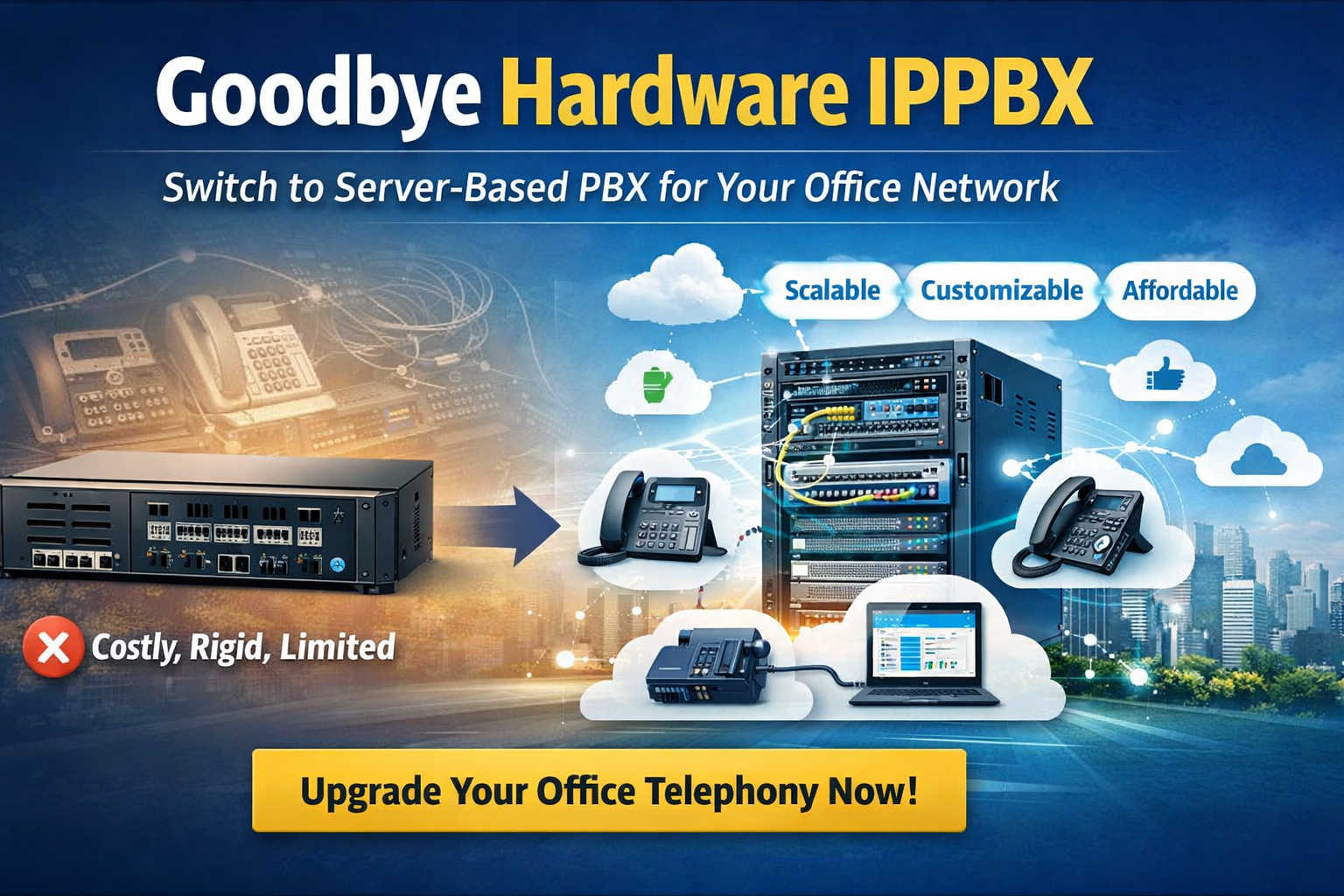
This is not just a cost optimization; it’s an architectural shift.
The Core Argument
A hardware IPPBX is essentially:
- A proprietary server
- Running a customized telephony OS
- With restricted access and limited extensibility
Today, you can replicate—and surpass—that functionality using:
- Asterisk(core SIP engine)
- FreeSWITCH(high concurrency/media handling)
- Modern backend frameworks (NestJS / Node.js)
- Standard servers (VMs, containers, bare metal)
Result: Your “PBX” becomes software—fully programmable, horizontally scalable, and API-driven.
What Replaces Device-Based IPPBX?
Software-Defined PBX (SD-PBX)
Instead of buying a $2,000–$20,000 appliance:
- Deploy a Linux server
- Install Asterisk / FreeSWITCH
- Connect: SIP phones / IP phones Softphones (mobile/desktop) SIP trunks (VoIP providers) Analog devices via FXS/FXO cards or gateways
You now have:
- Unlimited extensions
- Full dial plan control
- API-driven call logic
- Integration with CRM, AI agents, analytics
Why Hardware IPPBX No Longer Makes Sense
1. Vendor Lock-In
- Limited features unless you pay for licenses
- No control over dial plan logic
- Difficult integrations
2. High CapEx
- Expensive upfront hardware
- Costly expansion modules
3. Limited Customization
- Cannot embed AI, workflows, or automation easily
4. Scalability Constraints
- Fixed port/channel limits
- Hardware upgrade required for growth
5. Maintenance Overhead
- Firmware dependencies
- Hardware failures
What You Gain with Server-Based PBX
Technical Advantages
- Full control of SIP routing
- Programmable call flows (IVR, queues, AI agents)
- Horizontal scaling via Kubernetes or clustering
- Database-driven voicemail, CDR, analytics
Business Advantages
- 60–80% cost reduction
- Faster feature deployment
- Integration-ready (CRM, WhatsApp, AI voice bots)
- Remote workforce enablement
Architecture Overview
Solution Flow
[IP Phones / Softphones]
            │
            ▼
     [SIP Server Layer]
 (Asterisk / FreeSWITCH)
            │
 ┌──────────┼──────────┐
 ▼          ▼          ▼
IVR     Call Queue   API Layer
                     │
                     ▼
           CRM / AI / Analytics
                     │
                     ▼
              Database Layer
        (PostgreSQL / Redis)
Extending to Analog (Without Expensive PBX)
Instead of proprietary PBX modules:
- Use PCI/PCIe telephony cards (FXS/FXO)
- Or SIP-based gateways
This enables:
- Direct analog phone/fax connectivity
- PSTN fallback
- Rural deployments
Key point: You don’t need a hardware PBX—you just need interfaces.
Real-World Use Cases by Industry
1. Insurance Companies
Problem: High inbound/outbound call volume, lead tracking
Solution:
- CRM-integrated dialer
- AI voice assistants for initial qualification
- Auto call logging
Outcome:
- Increased conversion rates
- Reduced agent workload
2. Corporate Office Environments
Problem: Internal communication + distributed teams
Solution:
- Extension-based calling
- Mobile softphones
- Presence + call routing
Outcome:
- Unified communication across offices
- Remote-ready infrastructure
3. Hospitals & Healthcare
Problem: Critical call routing, departments, emergency handling
Solution:
- IVR for department navigation
- Priority queues for emergency lines
- Integration with patient systems
Outcome:
- Reduced response time
- Better patient experience
4. Agencies (Marketing / BPO / Sales)
Problem: Outbound campaigns + performance tracking
Solution:
- Predictive dialers
- Call recording + analytics
- AI-based conversation summaries
Outcome:
- Higher agent productivity
- Data-driven decisions
5. WAN-Based Enterprises (Multi-Location)
Problem: Multiple branches with siloed PBX systems
Solution:
- Centralized PBX in cloud/data center
- Offices connected via VPN/MPLS
- Local breakout with SIP trunks
Outcome:
- Single unified communication system
- Reduced inter-office call cost
6. WiFi-to-WiFi Connected Offices
Problem: No structured telephony infrastructure
Solution:
- Softphones over WiFi
- WebRTC-based calling
- Cloud-hosted PBX
Outcome:
- Zero hardware dependency
- Rapid deployment
7. Railways & Large Transport Networks
Problem: Distributed communication across stations
Solution:
- Central SIP core
- Edge gateways at stations
- Priority routing for operations
Outcome:
- Reliable, scalable communication backbone
8. Government Offices
Problem: Legacy systems, compliance, budget constraints
Solution:
- On-prem secure PBX
- Role-based routing
- Call logging + audit trails
Outcome:
- Cost-effective modernization
- Full control + compliance
Migration Strategy: From Hardware PBX to Software PBX
Phase 1: Assessment
- Inventory current extensions, trunks, IVR flows
- Identify dependencies (fax, analog lines)
Phase 2: Parallel Setup
- Deploy new server (on-prem/cloud)
- Configure SIP environment
- Integrate with existing network
Phase 3: Gradual Migration
- Move departments one by one
- Use SIP trunk bridging between old and new
Phase 4: Testing
- Call routing validation
- Load testing (concurrent calls)
- Failover scenarios
Phase 5: Cutover
- Switch primary SIP routing
- Decommission old PBX
Phase 6: Optimization
- Add automation, AI, analytics
- Fine-tune call flows
Key Technical Stack (Recommended)
- Telephony Core: Asterisk / FreeSWITCH
- Backend APIs: NestJS / Node.js
- Database: PostgreSQL + Redis
- Frontend Dashboard: Next.js / React
- Deployment: Docker + Kubernetes
- Monitoring: Prometheus + Grafana
Cost Comparison (India Context)
Final Takeaway
Hardware IPPBX is not “dead”—but it is architecturally outdated.
The future is:
- Software-defined
- API-driven
- AI-integrated
- Cloud or hybrid deployed
If your PBX cannot integrate with your CRM, automate workflows, or scale dynamically—it’s not a communication system anymore. It’s a bottleneck.
Strategic Insight
The real shift is not PBX → VoIP. It is:
Telephony → Programmable Communication Infrastructure
Organizations that understand this are not just reducing costs—they are building communication as a competitive advantage.
If you're exploring similar solutions or want to implement this in your business, I’m open to a quick discussion. Let’s evaluate your use case and identify the most efficient approach to get results.