A customer calls your company.
The PBX knows about the call.
Your CRM knows about the customer.
WhatsApp knows about the conversation.
Your ERP knows about the order.
Your support system knows about the ticket.
Your sales team knows about the opportunity.
And yet...
none of these systems necessarily know what the others just learned.
That is one of the biggest problems I see in modern business software.
Companies keep adding AI assistants, chatbots, communication channels and automation tools.
But the underlying systems remain fragmented.
The result is a strange situation:
Businesses are becoming more automated while their customer information remains disconnected.
I believe the next stage of business software is not simply "adding AI."
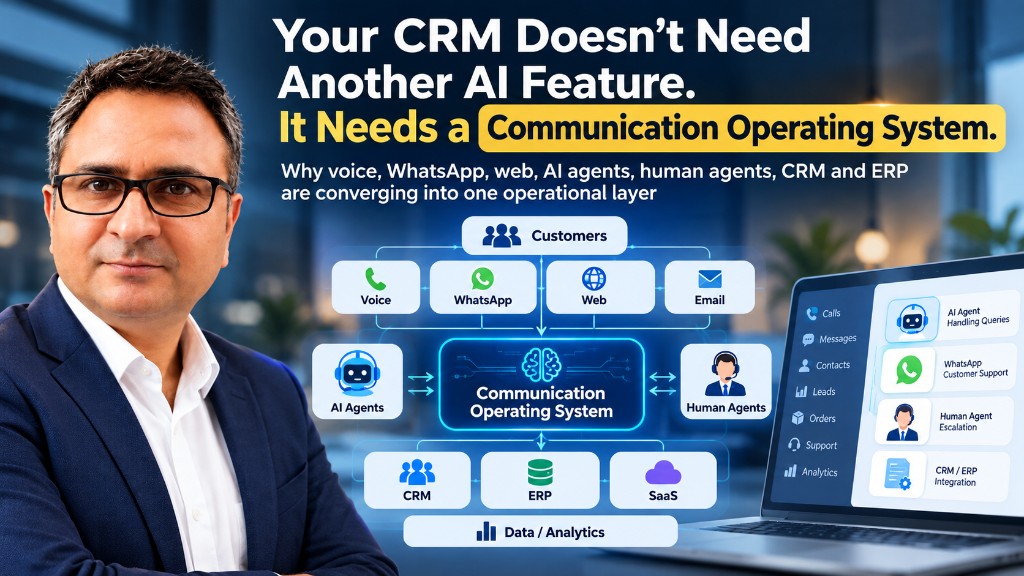
It is building a Communication Operating System that connects customer conversations, business data, AI and human workflows.
The Problem Isn't Lack of AI
Let's look at a typical modern business.
It may have:
- CRM for leads and customers
- ERP for orders, billing and operations
- PBX or CCaaS for voice
- WhatsApp for customer communication
- Email for business communication
- Website forms and chat
- Helpdesk for support
- AI chatbot
- AI voice agent
- Analytics platform
- Separate databases and APIs
Individually, these systems can work very well.
The problem appears at the boundaries.
A customer calls the sales team.
The salesperson talks to the customer for 15 minutes.
Important information is exchanged.
But what happens next?
Someone may manually update the CRM.
Perhaps a follow-up task is created.
Maybe the conversation is recorded.
Perhaps the AI generates a transcript.
But the ERP doesn't know what happened.
The support system doesn't know.
The marketing system doesn't know.
And another employee may later ask the customer for information they already provided.
This isn't primarily an AI problem.
It is an architecture problem.
The Traditional Architecture
For years, businesses have built systems approximately like this:
                    Customer
                       |
        +--------------+--------------+
        |              |              |
       Voice        WhatsApp         Web
        |              |              |
       PBX         Messaging       Website
        |              |              |
        +--------------+--------------+
                       |
                      CRM
                       |
                      ERP
It looks connected on paper.
But in practice, each system often has its own:
- authentication
- customer records
- business rules
- event model
- integrations
- reporting
- automation
- permissions
So the organization ends up building dozens of point-to-point integrations.
CRM ───── ERP
 │         │
 │         ├──── Billing
 │
 ├──── PBX
 │
 ├──── WhatsApp
 │
 ├──── Email
 │
 ├──── Helpdesk
 │
 └──── AI
As the number of systems grows, integration complexity grows rapidly.
And eventually, the business starts spending more time maintaining integrations than improving the customer experience.
The Communication Operating System
What if we approached the architecture differently?
Instead of treating voice, messaging, AI and business applications as isolated products, we can introduce a communication and orchestration layer between the customer and the business systems.
                         CUSTOMER
                            |
          +-----------------+-----------------+
          |                 |                 |
        Voice           WhatsApp             Web
          |                 |                 |
          +-----------------+-----------------+
                            |
                Communication Layer
                            |
                 AI + Human Agents
                            |
                 Business Orchestration
                            |
          +-----------------+-----------------+
          |                 |                 |
         CRM               ERP              SaaS
          |                 |                 |
          +-----------------+-----------------+
                            |
                       Data / Analytics
The key difference is that communication is no longer an isolated application.
It becomes an operational layer.
What Does This Actually Mean?
Imagine a customer sends a WhatsApp message:
"I want to know whether my policy is still active."
Instead of the WhatsApp system simply returning a chatbot response:
WhatsApp
   ↓
AI
   ↓
Answer
the Communication Operating System can do this:
WhatsApp
   ↓
AI understands intent
   ↓
Identify customer
   ↓
Authenticate / validate context
   ↓
Query CRM
   ↓
Query Insurance ERP
   ↓
Retrieve policy information
   ↓
Apply business rules
   ↓
Generate response
   ↓
Update conversation history
   ↓
Create follow-up if required
   ↓
Escalate to human agent if necessary
Now AI isn't just answering questions.
AI is participating in the business process.
That distinction is important.
AI Should Be Inside the Workflow
There is a tendency to think about AI as a separate feature:
"Let's add an AI chatbot."
Or:
"Let's add an AI voice agent."
But the more interesting question is:
What can the AI actually do inside the business?
Can it:
- access customer information?
- understand previous conversations?
- check an order?
- check an insurance policy?
- create a ticket?
- update a CRM opportunity?
- schedule an appointment?
- trigger an outbound campaign?
- send WhatsApp messages?
- escalate to a human?
- initiate a workflow?
- create a follow-up?
- record structured business information?
If the answer is no, you may have an AI interface.
You don't necessarily have an AI-powered business workflow.
Example: Insurance
Consider an insurance company.
A customer calls:
"I need to know whether my vehicle policy is active."
A traditional IVR might do:
Press 1 for policy information.
Press 2 for claims.
Press 3 for renewal.
A basic AI voice agent might understand the question.
But a properly integrated architecture can go much further:
Customer
   ↓
Voice
   ↓
AI Voice Agent
   ↓
Customer Identification
   ↓
CRM
   ↓
Insurance ERP
   ↓
Policy Service
   ↓
Business Rules
   ↓
Response
   ↓
Conversation Record
The system can potentially determine:
- who the customer is
- which policy they are referring to
- policy status
- renewal date
- relevant business rules
- whether human intervention is required
And the entire interaction can become part of the customer's operational history.
Example: Real Estate
Imagine a real-estate company receiving hundreds of inquiries.
A prospect says:
"I'm looking for a 3-bedroom apartment near the metro, under ₹1.5 crore."
The communication layer can capture:
Budget       → ₹1.5 crore
Bedrooms     → 3
Location     → Metro proximity
Intent       → Purchase
Lead status  → Qualified
Then:
AI
 ↓
CRM
 ↓
Property database
 ↓
Matching engine
 ↓
Available properties
 ↓
Customer response
 ↓
Salesperson assignment
The salesperson doesn't receive just:
"New lead."
They receive:
Qualified buyer — 3 BHK — ₹1.5 Cr budget — wants metro proximity — interested in these properties.
That is a completely different operational experience.
Example: D2C / E-Commerce
Consider a customer sending:
"Where is my order?"
The AI shouldn't need to ask:
"Please provide your order number."
if the system already knows who the customer is and has the appropriate authorization.
The workflow could be:
WhatsApp
   ↓
Customer Identification
   ↓
CRM
   ↓
Order Management System
   ↓
Shipping API
   ↓
Current Status
   ↓
AI-generated response
   ↓
Conversation history
And if the shipment is delayed:
Shipment delayed
      ↓
Business rule
      ↓
Create support case
      ↓
Notify customer
      ↓
Escalate if threshold exceeded
Now communication is connected to operations.
Human Agents Don't Disappear
A Communication Operating System is not about replacing humans everywhere.
It is about deciding where automation makes sense and where humans create more value.
A good architecture might look like:
                   Customer
                      |
                 AI / Automation
                      |
              +-------+-------+
              |               |
          Resolvable       Complex
              |               |
          AI handles      Human Agent
                              |
                         Supervisor
AI can handle:
- repetitive questions
- information retrieval
- qualification
- scheduling
- basic support
- status checks
- data collection
- routine transactions
Humans can handle:
- complex cases
- negotiations
- exceptions
- sensitive conversations
- escalations
- high-value customers
- decisions requiring judgment
The objective isn't:
AI versus humans.
The objective is:
AI + humans + business systems working from the same context.
The Importance of Context
This is where the architecture becomes especially interesting.
Imagine a customer has:
- 3 previous phone calls
- 2 WhatsApp conversations
- 1 support ticket
- 1 open sales opportunity
- 1 pending order
If every channel treats the customer as a new conversation, the business repeatedly loses context.
Instead:
                 CUSTOMER ID
                      |
        +-------------+-------------+
        |             |             |
      Voice        WhatsApp        Web
        |             |             |
        +-------------+-------------+
                      |
               Conversation
                 History
                      |
             Business Context
                      |
          +-----------+-----------+
          |                       |
         CRM                     ERP
The customer's identity and context become more important than the communication channel.
The customer should not have to care whether they contacted you through:
- phone
- website
- mobile application
The business should maintain continuity.
Event-Driven Architecture Makes This More Powerful
At scale, I would not build every integration as a synchronous point-to-point API call.
An event-driven architecture can provide a cleaner model.
For example:
Customer.Call.Completed
        ↓
Conversation.Transcribed
        ↓
AI.Intent.Detected
        ↓
CRM.Activity.Created
        ↓
Customer.Followup.Required
        ↓
Sales.Task.Created
Another example:
Order.Delayed
      ↓
Customer.Notification.Required
      ↓
WhatsApp.Message.Created
      ↓
Customer.Notified
      ↓
Support.Case.Created
This allows different services to react to business events without creating tightly coupled integrations everywhere.
Where the Technology Fits
A communication operating layer can involve technologies such as:
Telephony
- SIP
- Asterisk
- FreeSWITCH
- WebRTC
- Twilio
- Telnyx
Backend
- Node.js
- NestJS
- Python
- FastAPI
- REST APIs
- WebSockets
- event-driven services
Data
- PostgreSQL
- Redis
- search/vector databases where appropriate
- event stores
AI
- Large Language Models
- speech-to-text
- text-to-speech
- RAG
- AI agents
- intent classification
- tool/function calling
Infrastructure
- Docker
- Kubernetes
- AWS
- Azure
- GCP
- Nginx
- Prometheus
- Grafana
But the technology stack isn't the most important part.
Architecture is.
You can build a sophisticated AI system with a poor architecture.
And you can build a relatively simple AI workflow that produces significant business value when the architecture is right.
Buy, Integrate, Extend or Build?
This is another important decision.
Not every company should build a custom Communication Operating System from scratch.
There are four broad strategies.
1. Buy
Use an existing platform when the business requirements are standard.
Good for:
- basic telephony
- standard CRM
- standard support
- simple contact centers
2. Integrate
Use existing systems but connect them properly.
For example:
Existing CRM
     +
Existing PBX
     +
WhatsApp
     +
AI
     +
ERP APIs
This can be the most practical approach for many businesses.
3. Extend
Start with an existing platform and build custom services around it.
For example:
CCaaS
  +
Custom AI
  +
Custom CRM integration
  +
Custom analytics
4. Build
Build a custom platform when communication itself is part of the company's product or competitive advantage.
This can make sense for:
- CPaaS providers
- SaaS companies
- telecom businesses
- BPOs
- specialized contact centers
- highly regulated workflows
- businesses with complex multi-tenant requirements
The right question isn't:
"Should we build everything?"
The better question is:
Which parts of our communication workflow create competitive differentiation?
Build those.
Buy the commodity components.
Integrate where appropriate.
Multi-Tenancy Changes Everything
For SaaS and communication platforms, architecture becomes even more important.
A multi-tenant communication system may need:
Tenant
  ↓
Users
  ↓
Contacts
  ↓
Phone Numbers / DIDs
  ↓
Channels
  ↓
AI Agents
  ↓
Campaigns
  ↓
Conversations
  ↓
Recordings
  ↓
Analytics
  ↓
Billing
Each tenant may have different:
- users
- permissions
- phone numbers
- SIP trunks
- workflows
- AI agents
- business rules
- integrations
- billing
- reporting
This is where communication infrastructure starts looking much more like a distributed SaaS platform than a traditional PBX.
Observability Is Part of the Architecture
There is another piece that is often ignored.
When voice, AI, CRM, ERP and messaging become one workflow, debugging becomes much harder.
Imagine:
Customer
 ↓
SIP
 ↓
FreeSWITCH
 ↓
AI service
 ↓
LLM
 ↓
CRM API
 ↓
ERP API
 ↓
WhatsApp
If the customer doesn't receive a response, where did it fail?
You need observability across the entire workflow.
That means tracking:
- request IDs
- tenant IDs
- conversation IDs
- call IDs
- latency
- API failures
- AI latency
- token usage
- SIP events
- queue events
- database operations
- business events
Tools such as Prometheus and Grafana can become part of the operational architecture rather than simply infrastructure monitoring.
The Future Isn't Another AI Feature
The real opportunity isn't adding one more chatbot.
It isn't adding one more voice assistant.
It isn't adding another CRM plugin.
The larger opportunity is connecting:
Communication + AI + Business Data + Automation + Humans
into a coherent operating layer.
The architecture might eventually look like this:
                         CUSTOMER
                            |
       +--------------------+--------------------+
       |                    |                    |
     Voice                WhatsApp              Web
       |                    |                    |
       +--------------------+--------------------+
                            |
                 COMMUNICATION LAYER
                            |
              +-------------+-------------+
              |                           |
           AI AGENTS                 HUMAN AGENTS
              |                           |
              +-------------+-------------+
                            |
                  BUSINESS ORCHESTRATION
                            |
          +----------------+----------------+
          |                |                |
         CRM              ERP             SaaS
          |                |                |
          +----------------+----------------+
                            |
                     EVENT / DATA LAYER
                            |
                     ANALYTICS + AI
The important part isn't the diagram.
It's the idea behind it.
The customer conversation becomes business data.
Business data becomes context.
Context makes AI more useful.
AI can trigger business actions.
Those actions become part of the next customer interaction.
That creates a continuous loop.
From Communication Platform to Business Operating Layer
This is where I believe many SaaS, CRM, ERP and CCaaS platforms are heading.
The boundary between these categories is becoming less clear.
A CRM can no longer assume that customer interaction happens somewhere else.
A contact center can no longer assume that business context lives somewhere else.
An AI agent can no longer operate effectively without access to business systems.
And an ERP can no longer assume that customer communication is somebody else's problem.
The systems are converging.
The Question CTOs and Founders Should Ask
Instead of asking:
"Which AI tool should we buy?"
Ask:
"Where does customer context live, and how does it move through our business?"
Then map the complete journey:
Customer
   ↓
Conversation
   ↓
Identity
   ↓
Context
   ↓
AI / Human
   ↓
Business Decision
   ↓
Action
   ↓
CRM / ERP
   ↓
Analytics
   ↓
Next Interaction
If you can trace that journey end-to-end, you can identify where automation actually creates value.
If you can't, adding another AI feature may simply create another disconnected system.
Final Thought
The next generation of business software won't be defined simply by whether it has AI.
It will be defined by how deeply intelligence is connected to the business workflow.
A voice agent that cannot access relevant business context is limited.
A chatbot that cannot trigger business actions is limited.
A CRM that cannot understand customer conversations is incomplete.
An ERP that cannot participate in customer workflows is disconnected.
The real opportunity is to build systems where:
customers, conversations, AI, humans, business data and automation operate as one connected system.
That is what I mean by a Communication Operating System.
And for many businesses, the question is no longer:
"How do we add AI?"
It is:
"How do we connect AI to the way our business actually works?"
Building a Communication Operating System?
If your business is dealing with fragmented voice, WhatsApp, CRM, ERP, AI agents, contact-center or SaaS workflows, the first step isn't necessarily choosing another platform.
It is mapping the architecture.
I work on the architecture and development of AI Voice, VoIP, CCaaS, CPaaS, multi-tenant SaaS, CRM/ERP integrations and communication platforms—from system design through backend, frontend, telephony, APIs, observability and deployment.
If you're planning a new communication platform or trying to connect an existing business stack, I'd be interested in hearing what you're building.
What part of your customer communication stack is currently the most disconnected?
Voice? WhatsApp? CRM? ERP? AI?
Share your experience in the comments. The most interesting architecture problems are often hidden between the systems—not inside them.