Turn fragmented digital evidence into detailed, investigator-validated analysis—email/PST, metadata, cloud, SaaS, APIs and VoIP—with AI-assisted correlation and timeline reconstruction.
AI DFIR · Timeline Reconstruction · Email / PST · Metadata · Cloud / SaaS · API · VoIP · Forensic Reports
This is technical digital evidence / DFIR capability—not a claim to operate a full forensic laboratory or to serve as a court-appointed legal expert. The edge is correlation across cloud, software, networks and telecom: evidence → timeline → incident response.
2026 BUYING BRIEF
What happened—and what evidence still exists?
Who this is for. Teams facing account compromise, suspicious API activity, SaaS incidents, email/PST disputes, unexplained data changes, VoIP fraud indicators or production failures that need reconstruction—not only a reboot.
What you get. AI-assisted detailed analysis: preserve what you can, correlate email/metadata/logs/telephony, rebuild a timeline and produce a technical forensic report. Optionally harden forensic readiness going forward.
When it makes sense. When “something doesn’t make sense” and you need identity, timestamps and actions across systems—not only a green check on one dashboard.
Searches this page answers: AI-powered digital forensics · AI DFIR · forensic timeline reconstruction · email / PST examination · metadata forensics · cloud / SaaS / API forensics · VoIP / SIP forensics · forensic readiness
AI accelerates correlation and report drafting; investigators validate evidence and own findings.
AI-powered detailed analysis
Modern DFIR buyers search for AI-powered digital forensics because manual timeline work does not scale across email archives, SaaS audit trails, APIs and VoIP logs. Industry platforms emphasize the same job: correlate fragmented signals, reconstruct timelines faster and surface relationships humans miss under volume—see approaches from ForensicFlex, ForensicAI and research on LLM/RAG timeline analysis (GenDFIR-style work).
How we use AI here (honest scope): classification, summarization, entity/link hints, anomaly surfacing and draft timeline narrative—always with human validation of source artifacts. AI does not replace evidence integrity, chain-of-custody discipline or investigator judgment.
Ingest multi-source evidence
Email/PST, CRM records, documents, EXIF/GPS where present, personnel links, cloud/SaaS audits, API logs, SIP/CDR and AI-agent tool trails.
Correlate & reconstruct
Normalize timestamps, connect identities and actions, build a causal timeline, flag gaps and contradictions for human review.
Detailed technical report
Findings, evidence map, chronology, open questions and remediation/readiness notes—in formats your engagement needs (not a court accreditation claim).
Keep the investigator in the loop
Every AI-suggested link is checkable against raw artifacts. No “black box truth” reports.
EVIDENCE SOURCES          AI ASSIST LAYER              HUMAN DFIR
email / PST  ─┐
CRM / apps   ─┤         classify · summarize
metadata     ─┼──────►  correlate · draft timeline ──► validate · report
cloud / API  ─┤         anomaly / link hints
SIP / CDR    ─┘
Email, PST & metadata forensics
Detailed analysis often starts in communications and documents—not only disk images. Typical examination themes:
PST / mailbox archives — structured extraction and search across large mail stores.
Document forensics — metadata, revision clues and attachment trails.
EXIF & GPS — when media files carry location/time artifacts that matter to the timeline.
Personnel / link analysis — who talked to whom, when, and which systems they also touched.
Email · CRM · metadata · EXIF/GPS · personnel links—correlated into one examination narrative.
What is digital forensics here?
Digital evidence is no longer only PCs and hard drives. Modern investigation spans cloud environments, SaaS audit trails, APIs, databases, containers, networks and communications systems. The work is to preserve, acquire, correlate and report—with clear limits on what can and cannot be claimed from available artifacts.
Investigate suspicious API activity, account misuse, data modification, deleted/changed records, webhook storms, service-to-service paths and abnormal application behavior—especially when there is no classic “filesystem” scene.
AI & agent forensics
User → AI Agent → Prompt → RAG → Tool Call → MCP
  → CRM API → Database → Action
What did the AI actually do? Investigate application logs, prompt history, tool calls, agent actions, MCP activity, model/API requests, retrieval, workflow execution, AI-generated actions, human approvals and policy gaps. Related: Private AI · AI Workflow Automation · AI & Workflow Automation.
Connects directly to observability practice: structured logs, metrics, PostgreSQL audit patterns, API gateways, Docker/Kubernetes and cloud IAM—so Friday’s incident has a trail.
Digital investigation lifecycle
Preserve — protect relevant evidence and document handling.
Acquire — collect available artifacts using appropriate methods.
Validate — check integrity and provenance where possible.
Normalize — align timestamps and formats.
Correlate — connect events across systems.
Analyze — identify relevant activity and anomalies.
Reconstruct — build a timeline of what happened.
Report — produce a technically documented result.
This page does not claim courtroom admissibility or legal certification unless that is separately scoped under the applicable jurisdiction and process.
Evidence correlation architecture
                    DIGITAL EVIDENCE
                           │
      ┌────────────────────┼────────────────────┐
      ▼                    ▼                    ▼
   ENDPOINT              CLOUD                NETWORK
      │                    │                    │
   MOBILE                SaaS                 SIP/RTP
      └────────────────────┼────────────────────┘
                           ▼
                    APPLICATIONS
                           │
               ┌───────────┼───────────┐
               ▼           ▼           ▼
             APIs         DB          AI
                           │
                           ▼
                    EVENT CORRELATION → TIMELINE
                           │
                           ▼
                    INVESTIGATION → TECHNICAL REPORT
Mobile, endpoint & connected devices
Mobile & endpoint evidence analysis may be part of an investigation. We do not advertise “certified mobile forensic extraction” as a default product without the required tools, procedures and experience. IoT / connected-device telemetry and gateway logs can be included as analysis architecture when those sources are available.
“Pankaj was highly responsive and quickly grasped the requirements for a complex digital forensics task. He delivered a thorough forensic report in multiple formats, proactively supplemented his work with additional analysis, and offered helpful guidance on tooling. Communication was prompt and professional throughout. Recommended for backend/forensics and data-parsing engagements.”
Upwork client · Endorsed by client · Mar 22, 2026 – Apr 23, 2026 · More reviews →
Digital Forensics training
Supporting education—not a claim of professional forensic accreditation or “Certified Digital Forensics Expert” status.
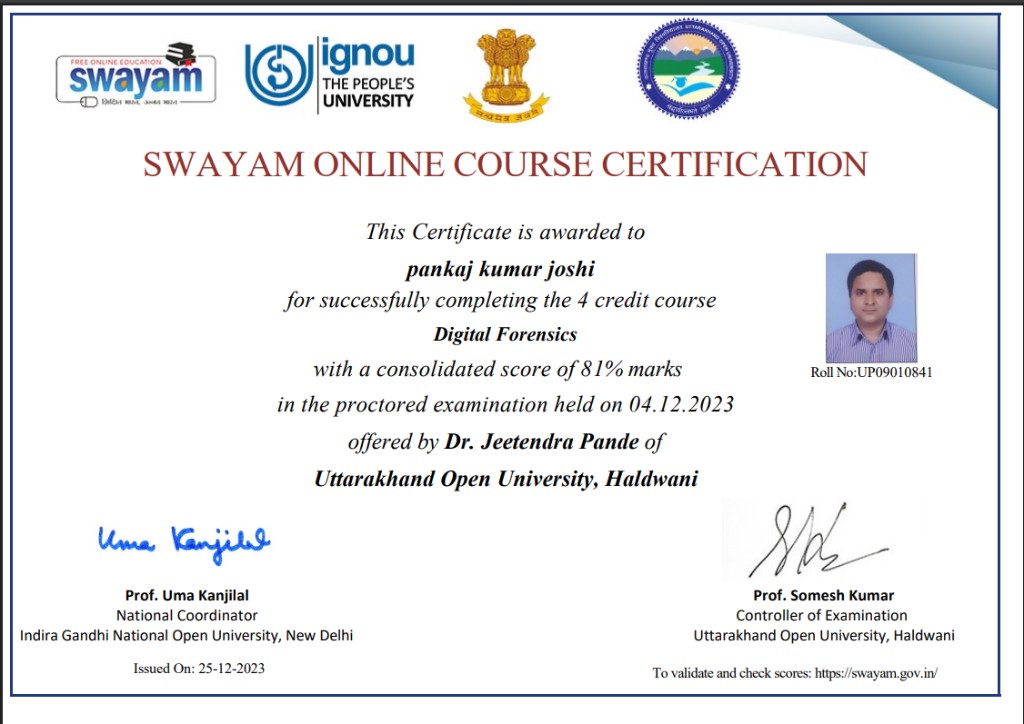
SWAYAM ONLINE COURSE CERTIFICATION
Digital Forensics
4-credit course · 81% consolidated score · Proctored examination 4 Dec 2023 · Certificate issued 25 Dec 2023
Offered by Dr. Jeetendra Pande, Uttarakhand Open University (Haldwani), under the SWAYAM / IGNOU framework. Awarded to Pankaj Kumar Joshi · Roll UP09010841.
Questions buyers ask about AI-powered digital forensics & DFIR
AI assist, detailed analysis scope, VoIP evidence and readiness—without overstating laboratory claims.
Using AI to accelerate detailed analysis—classify artifacts, summarize logs, correlate email/metadata/API/VoIP events and draft timelines—while investigators validate evidence and own the final report. AI assists; it does not replace chain-of-custody discipline or human judgment.
Email/PST examination and correlation, CRM and application records, document/metadata forensics, EXIF and GPS clues where present, personnel/link analysis, cloud/SaaS/API trails, VoIP/SIP evidence and AI-agent action reconstruction into a technical report.
No. This page describes technical digital evidence analysis, forensic readiness and DFIR-oriented investigation support. It does not claim courtroom accreditation, certified mobile extraction lab capability or legal-expert witness services unless separately contracted under applicable jurisdiction.
Preserving, collecting and correlating digital evidence across systems—cloud, SaaS, applications, APIs, databases, networks and communications—to reconstruct what happened and produce a technical report.
Yes. SIP signaling, registration, call-flow reconstruction, CDR, RTP/session clues, PBX logs, WebRTC evidence and correlation with application or CRM events are a core niche.
Designing audit logging, centralized events, time synchronization, retention and integrity controls so evidence can be collected effectively when an incident occurs—not only after systems are already opaque.
Yes—classification, log/mailbox summarization, timeline drafts and anomaly/link hints. See AI-powered detailed analysis. AI does not replace evidence validation or investigator judgment.
Production Rescue restores live traffic. Digital Forensics asks what evidence exists, what can be reconstructed and how systems should be ready for investigation. They often follow each other. See Production Rescue.
Not as a default advertised lab service. Mobile and endpoint artifacts can be discussed as analysis capability; specialized acquisition tools and procedures are required for formal mobile extraction work.
SWAYAM Online Course Certification — Digital Forensics: 4-credit course, 81% consolidated score, proctored examination December 2023. Supporting education, not professional forensic accreditation. See credential section.
Describe the incident or question in one paragraph, systems involved (cloud, SaaS, PBX, apps), available logs, and whether the goal is readiness, investigation or report. Do not paste secrets into email. Use the project brief or hello@unifiedpbx.in.
Founders, CTOs, telecom leads and product teams who need technical reconstruction after a compromise, suspicious API activity, SaaS incident, VoIP fraud indicators or unexplained production change—not buyers seeking a courtroom lab.
Discuss a technical investigation
Send the incident summary, systems involved and whether you need readiness, reconstruction or a report. Secrets stay out of email.