- Product class
- Multi-tenant AI CRM + automation SaaS
- Personas
- Platform admin · tenant admin · staff
- Scope authority
- EAIBAP-SCOPE-001 (baseline blueprint)
- Voice
- FreeSWITCH ESL · call sessions in product DB
- Honest limit
- Not a generic “AI replaces your CRM” claim — modules are scoped and verified per release
Business problem → engineering approach
- Business problem: revenue and operations teams lose traceability when CRM, dialers, campaigns and AI pilots are separate products with ad-hoc integrations.
- Engineering response: a modular monolith (Go API + PostgreSQL domain schemas) with session-bound tenancy, integration hub, workflow engine and optional
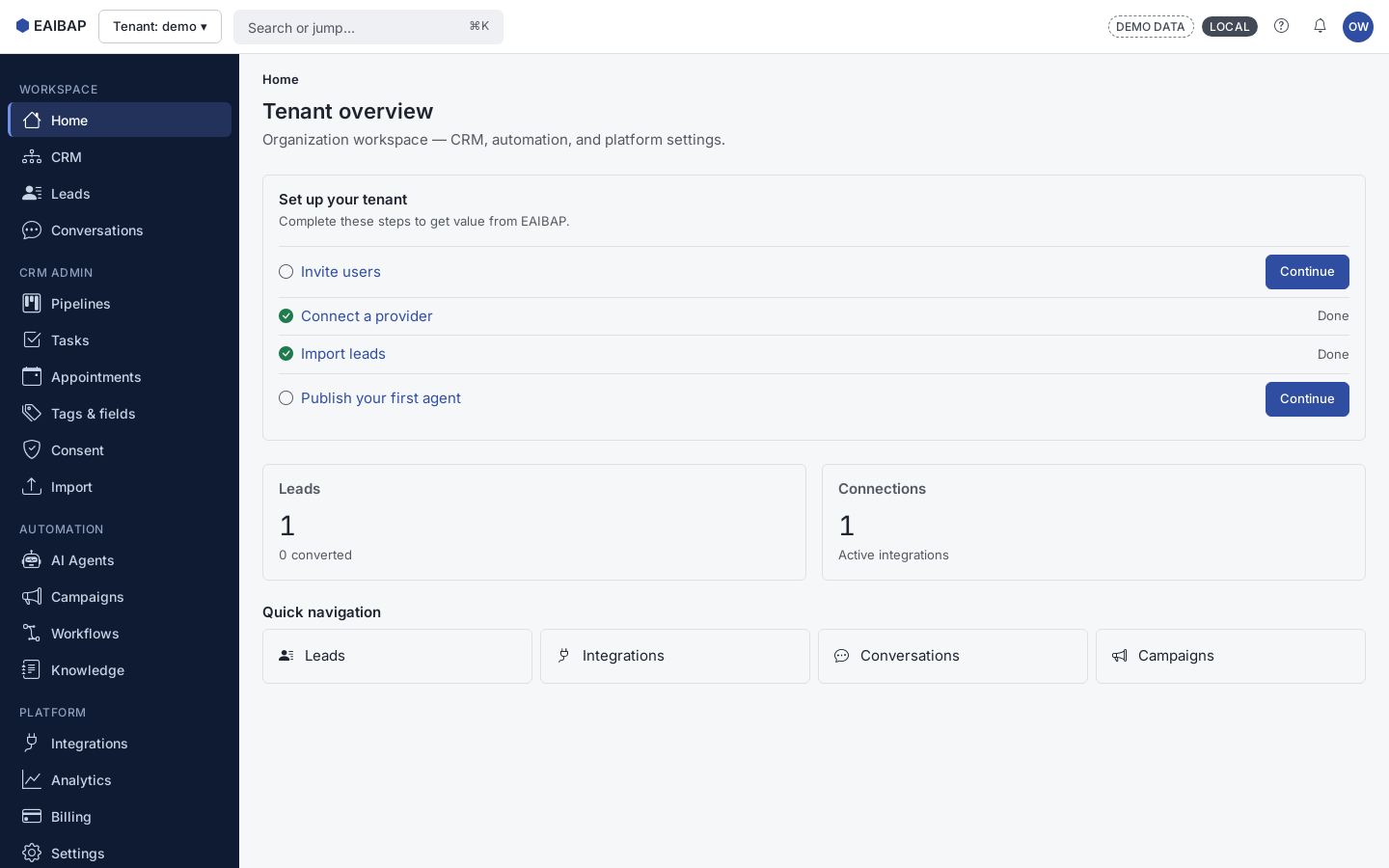
voice-orchestratorbeside FreeSWITCH—not replacing the media switch. - Verified capabilities: IAM/tenant paths, CRM + leads APIs, integration webhooks, workflow/campaign CRUD, AI agent lifecycle UI, ESL smoke path—see status matrix below.
- Remaining gaps: streaming STT/TTS at scale, full RAG ingestion, enterprise OIDC SSO—tracked per requirement ID until Verified / Production Ready.
- Delivery roadmap: phased acceptance (discovery → foundation → workflows → AI/voice → production readiness) aligned to modules selected on the product page.
The problem (technical framing)
Revenue teams run CRM, dialers, campaigns and AI experiments in separate tools. Integrations are one-offs; tenant isolation, consent and audit trails are inconsistent. Voice is often bolted on without shared call-session state in the product database.
EAIBAP targets a modular monolith: one PostgreSQL system of record, persona-specific Vue 3 surfaces, and a voice orchestrator that does not pretend to be the PBX.
Seven product pillars
- AI CRM and work management (accounts, opportunities, cases, tasks)
- Voice and conversational AI (agents, orchestration, handoff)
- Lead generation and engagement (imports, consent, routing)
- Workflow and process automation (graph designer, runs)
- AI knowledge and assistance (tenant-scoped RAG)
- Integration hub (connections, mappings, webhooks)
- Analytics and governance (audit, metering hooks)
Documentation authority (beyond UI)
The product is governed by EAIBAP-SCOPE-001 (full scope blueprint). Engineering docs in the solvedRevOps repository describe architecture, APIs, and delivery gates — the public site summarizes them; a scoped engagement includes the living doc set.
- ARCHITECTURE.md — system context, components, migrations, request flows
- DOMAIN_MODEL.md — entities and state machines (leads, workflows, campaigns, tenants)
- PRODUCT_REQUIREMENTS.md — requirement IDs (TEN-, IAM-, CRM-, VOICE-, …) with priority and release phase
- VOICE_TELEPHONY_DESIGN.md — SIP → FreeSWITCH → ESL → orchestrator; degradation paths
- GAP_ANALYSIS.md — what is wired in code vs still production-hardening
- API_CONTRACTS.md + OpenAPI — REST surface for Vue UI and integrations
- DEPLOYMENT.md, RUN_LOCAL.md, SRE runbooks — operability
Capabilities are not “done” because a screen exists — each requirement carries status: Planned → In Progress → Implemented → Verified → Production Ready.
System architecture
Modular monolith in Go (Gin); PostgreSQL schemas per domain; async work via RabbitMQ workers and scheduler. The Vue 3 SPA talks HTTPS + Bearer JWT to the API. Voice is isolated in apps/voice-orchestrator (ESL to FreeSWITCH, internal port).
flowchart TB
  subgraph clients [Clients]
    Web[Vue3_Web_UI]
    FS[FreeSWITCH]
    Ext[External_webhooks]
  end
  subgraph eaibap [EAIBAP]
    API[apps_api_8080]
    Voice[voice_orchestrator_8090]
    Worker[worker]
    Sched[scheduler]
  end
  subgraph data [Data]
    PG[(PostgreSQL)]
    Redis[(Redis)]
    MQ[RabbitMQ]
  end
  Web -->|REST| API
  API --> PG
  API --> Voice
  Voice -->|ESL| FS
  Voice --> PG
  Worker --> PG
  Worker --> MQ
  Ext -->|integrations_inbound| API
Logical modules
| Module | Schema | Responsibility |
|---|---|---|
| Identity & tenant | iam | Tenants, users, roles, teams, sessions |
| CRM | crm | Leads, parties, accounts, pipelines, consent |
| Communications | comm | Conversations, call sessions, messages |
| AI | ai | Agents, versions, deployments |
| Knowledge | kb | Sources, documents, chunks (RAG path) |
| Workflows | wf | Definitions, runs, outbox |
| Campaigns | camp | Campaigns, sequences, enrollments |
| Integrations | integ | Connections, webhooks, mappings, events |
| Billing / analytics / audit | billing, analytics, audit | Usage, rollups, DSR, audit log |
Deployable processes
| Process | Port | Role |
|---|---|---|
apps/api | 8080 | REST API, auth, CRUD |
apps/voice-orchestrator | 8090 | ESL, call control (internal only) |
apps/worker | — | Workflow steps, webhook delivery |
apps/scheduler | — | Campaigns, SLA, retention jobs |
web (Vite) | 5173 | Vue UI; proxies API in dev |
Key request flows
- Sign-in —
POST /api/v1/auth/login→ IAM session → Bearer token for all tenant APIs. - CRM — Handlers enforce
crm.record.*permissions; every row carriestenant_idfrom session (not a trusted client header). - Outbound test call — UI → API → voice orchestrator → ESL
originate→comm.call_sessions. - Inbound — FreeSWITCH dialplan → HTTP callback to orchestrator → session state + ESL
CHANNEL_*updates. - Integration webhook —
POST /integrations/inbound/:providerwith dedupe on provider event ID.
Domain lifecycles (examples)
- Lead: new → validating → qualified → assigned → working → converted / closed
- Workflow run: queued → running → waiting_approval → succeeded / failed / dead_letter
- AI agent version: draft → validated → published → deprecated
- Campaign: draft → scheduled → running → paused / completed
- Tenant: provisioning → active → suspended → closed
Voice and telephony
Media path: SIP → FreeSWITCH → ESL adapter → voice-orchestrator → STT/LLM/TTS adapters → tool layer → async persist to CRM, audit, billing. Real-time loop avoids blocking DB or long LLM calls on the media thread. ESL is not exposed publicly; recording/transcript access uses separate permissions (COM-008).
Degradation examples: STT failure → DTMF/transfer; LLM failure → fallback model or scripted response; object storage failure → disable new recordings only.
Industry packs (scope)
Insurance, banking/collections, cross-industry outreach, and general business operations packs are versioned modules — not hard-coded tenant conditionals in core CRM.
Implementation status matrix
Statuses are engineering gates—not marketing labels. “Implemented” means wired in codebase; “Verified” means agreed test evidence; “Production Ready” means operational checklist for your environment.
| Capability | Status | Evidence / acceptance condition |
|---|---|---|
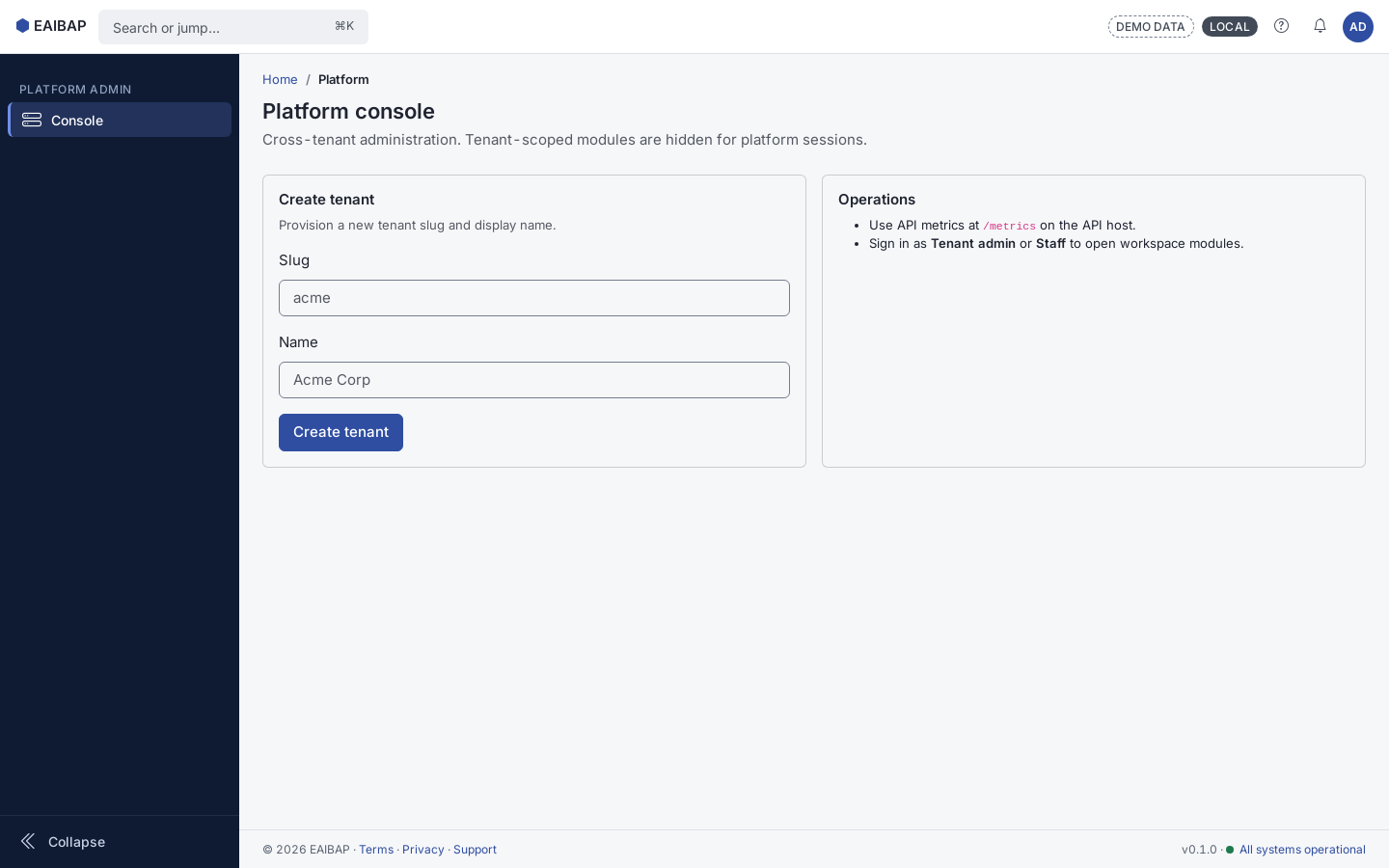
| IAM, tenants, RBAC | Implemented → Verified (partial) | pkg/iam, platform console, persona logins; SSO = Planned production gate |
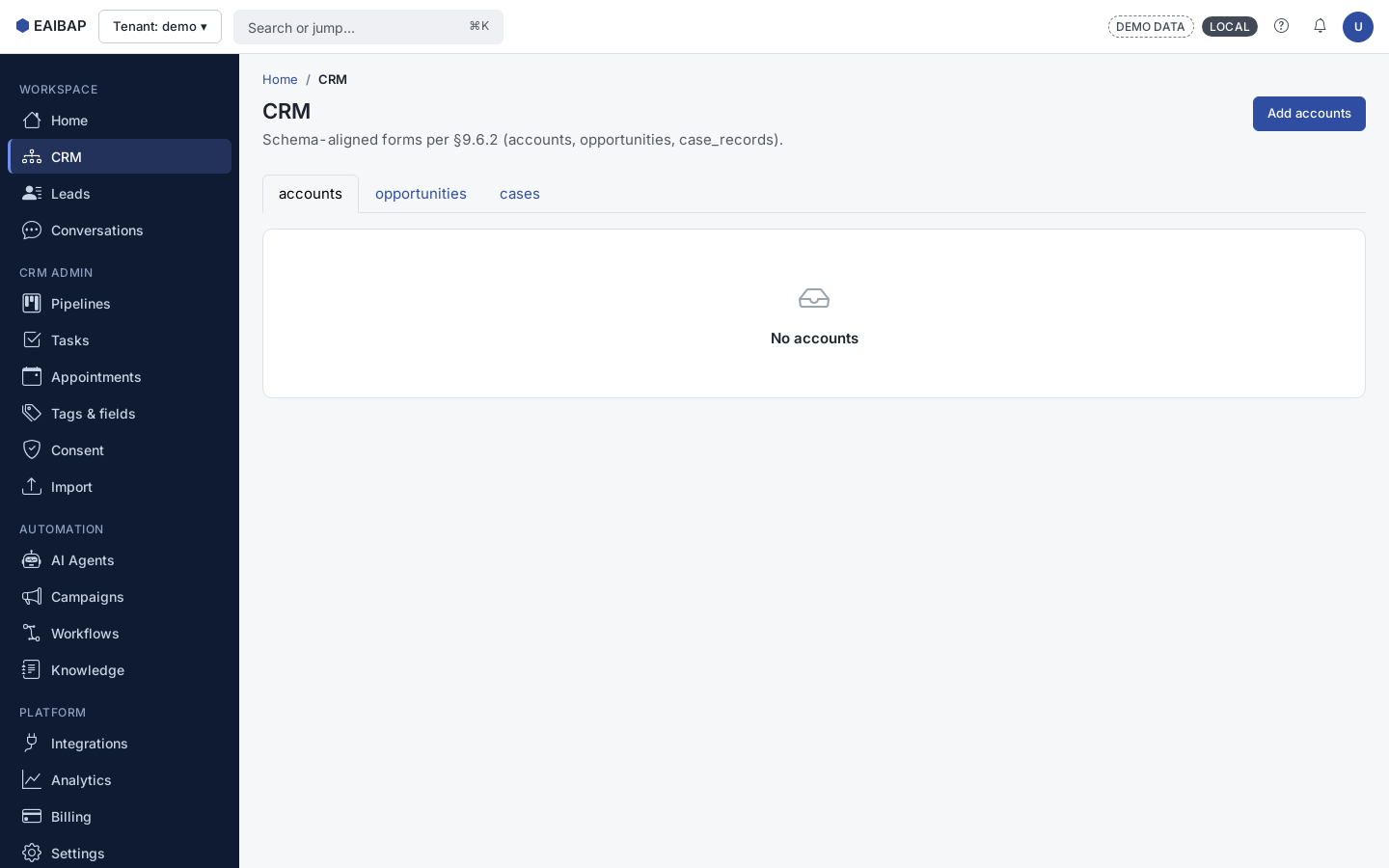
| CRM & leads APIs + UI | Implemented | pkg/crm, schema-aligned forms, permission-enforced handlers |
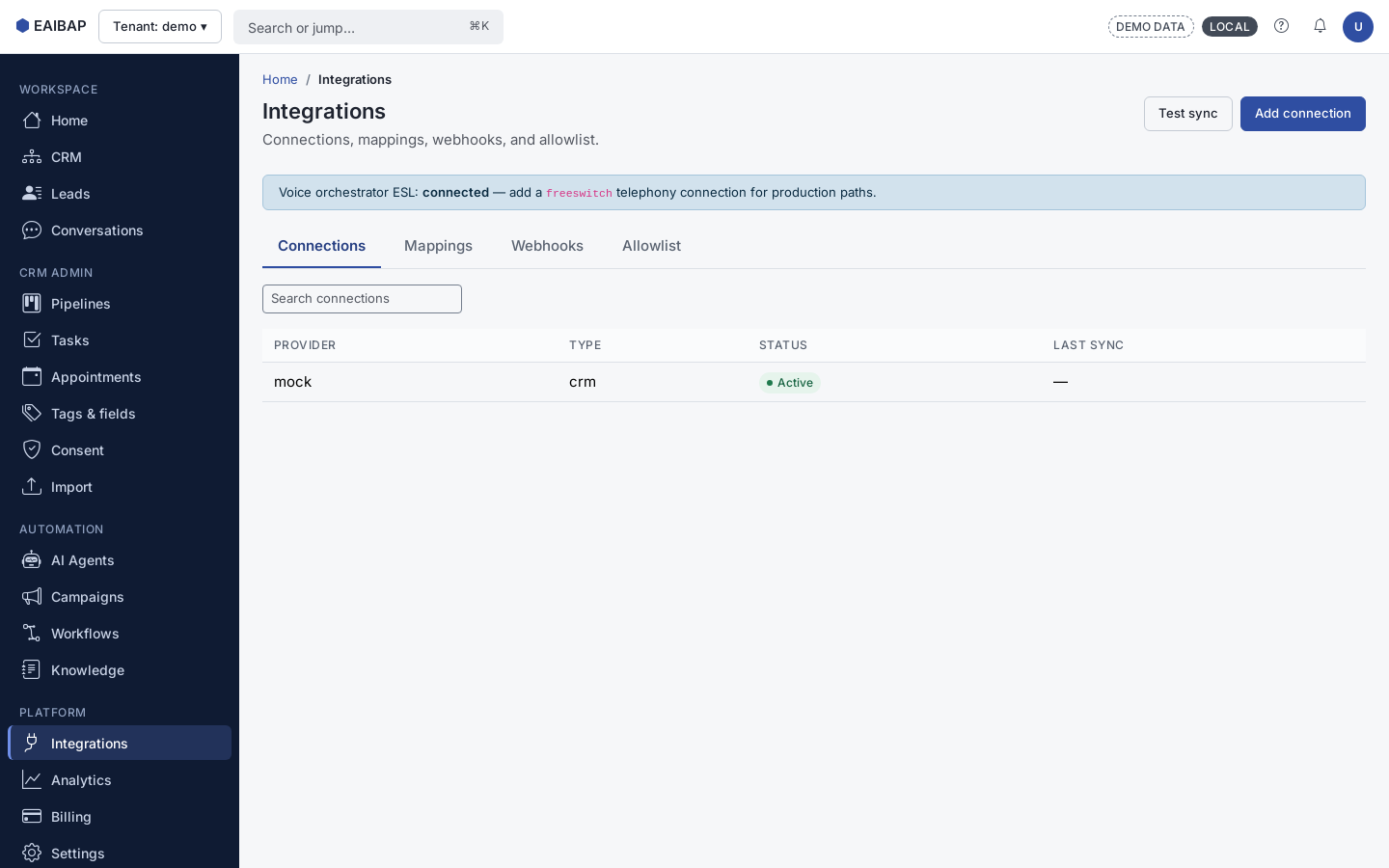
| Integration hub | Implemented | Connections, mappings, inbound webhook dedupe, worker relay |
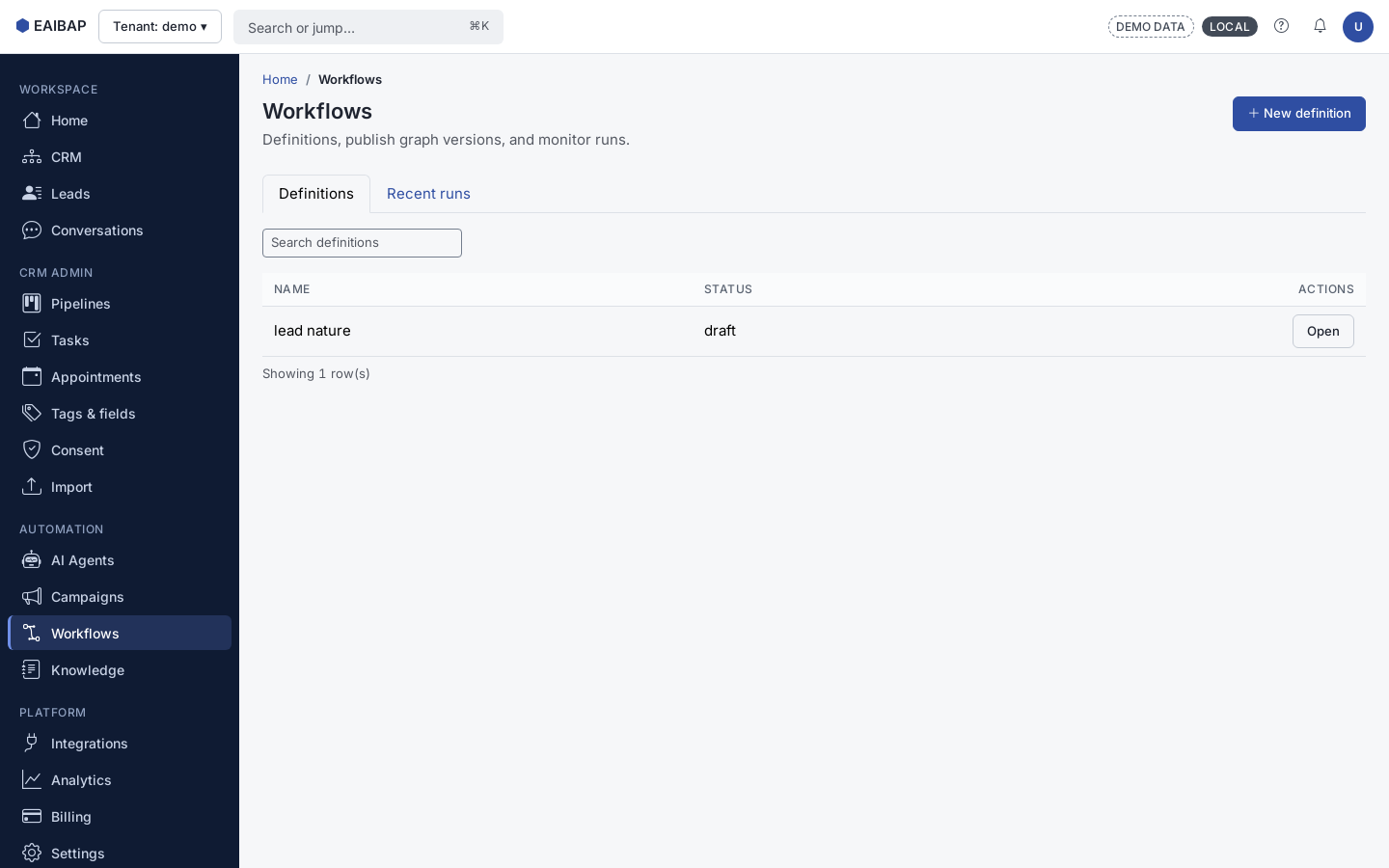
| Workflow engine | Implemented | Graph editor, definitions, run records; approval paths per scope |
| Campaigns | Implemented (core CRUD) | Definitions + enrollments; scale/eligibility hardening ongoing |
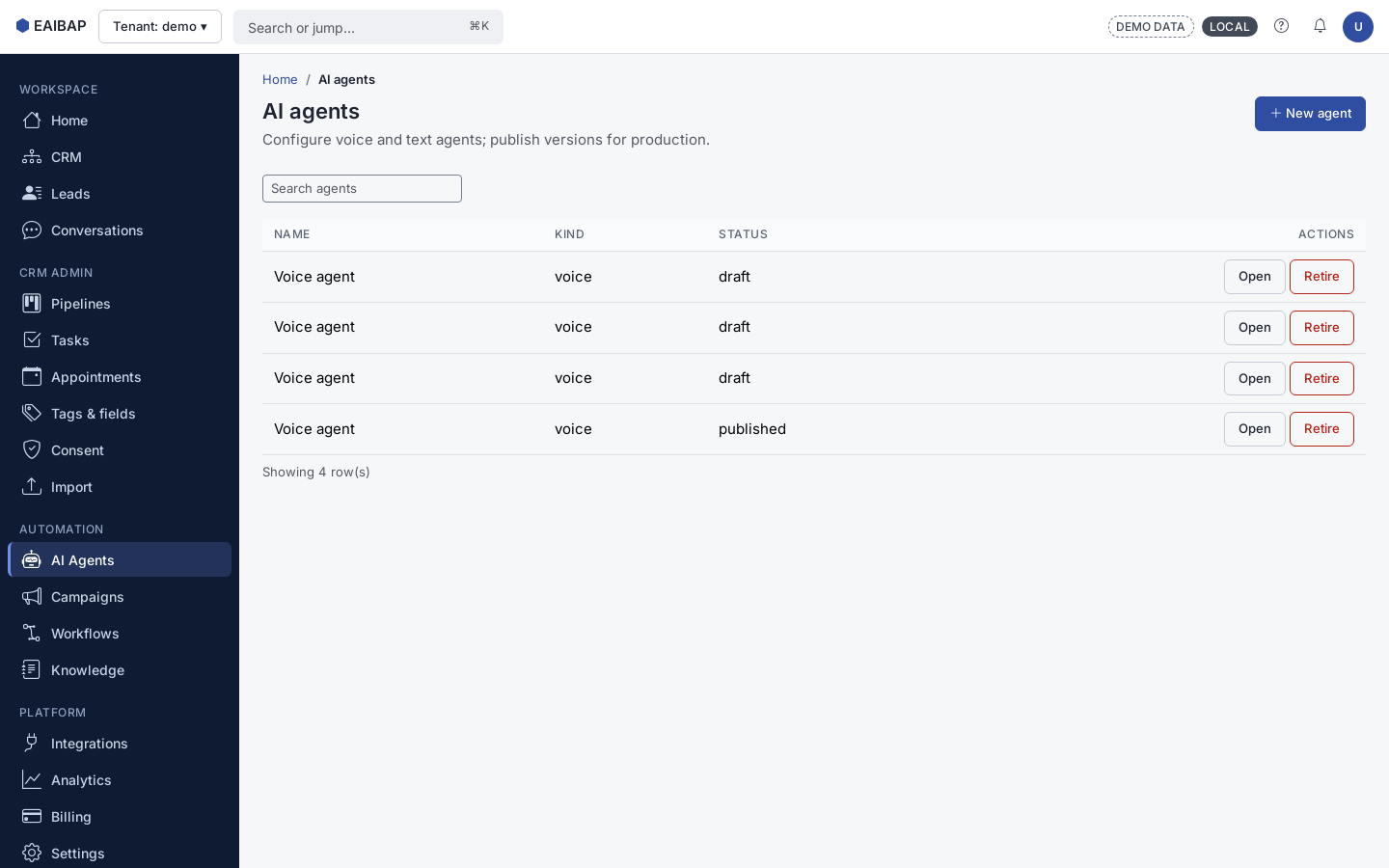
| AI agents (config) | Implemented | Versions, deployments UI; production STT/LLM/TTS scale = gate |
| Knowledge / RAG | Planned → partial | Schema path; full ingestion pipeline not production-certified |
| Voice orchestrator | Implemented (smoke) → Verified pending | ESL path, comm.call_sessions; load & language matrix in discovery |
| Audit & observability | Planned / partial | Hooks in scope; SRE runbooks depend on deployment tier |
Gap analysis summary
From repo GAP_ANALYSIS.md: streaming speech at scale, full RAG ingestion, enterprise OIDC SSO and many requirement IDs remain Planned until verified. UI screenshots do not imply Production Ready.
| Area | Evidence in build |
|---|---|
| IAM / tenants | pkg/iam, tenant provisioning UI, RBAC migrations |
| CRM / leads | pkg/crm, Leads/CRM views, §9.6-aligned forms |
| Voice | apps/voice-orchestrator, comm.call_sessions, dialplan curl inbound |
| Integrations | Connections, webhooks, inbound dedupe, worker relay |
| Workflows / campaigns | Graph editor UI, definitions + runs |
Explicit non-goals (initial core)
Not a core banking system, policy admin, universal ERP replacement, or autonomous approver for regulated credit/claims decisions. Platform features do not by themselves prove legal compliance — customer policy and jurisdiction still apply.
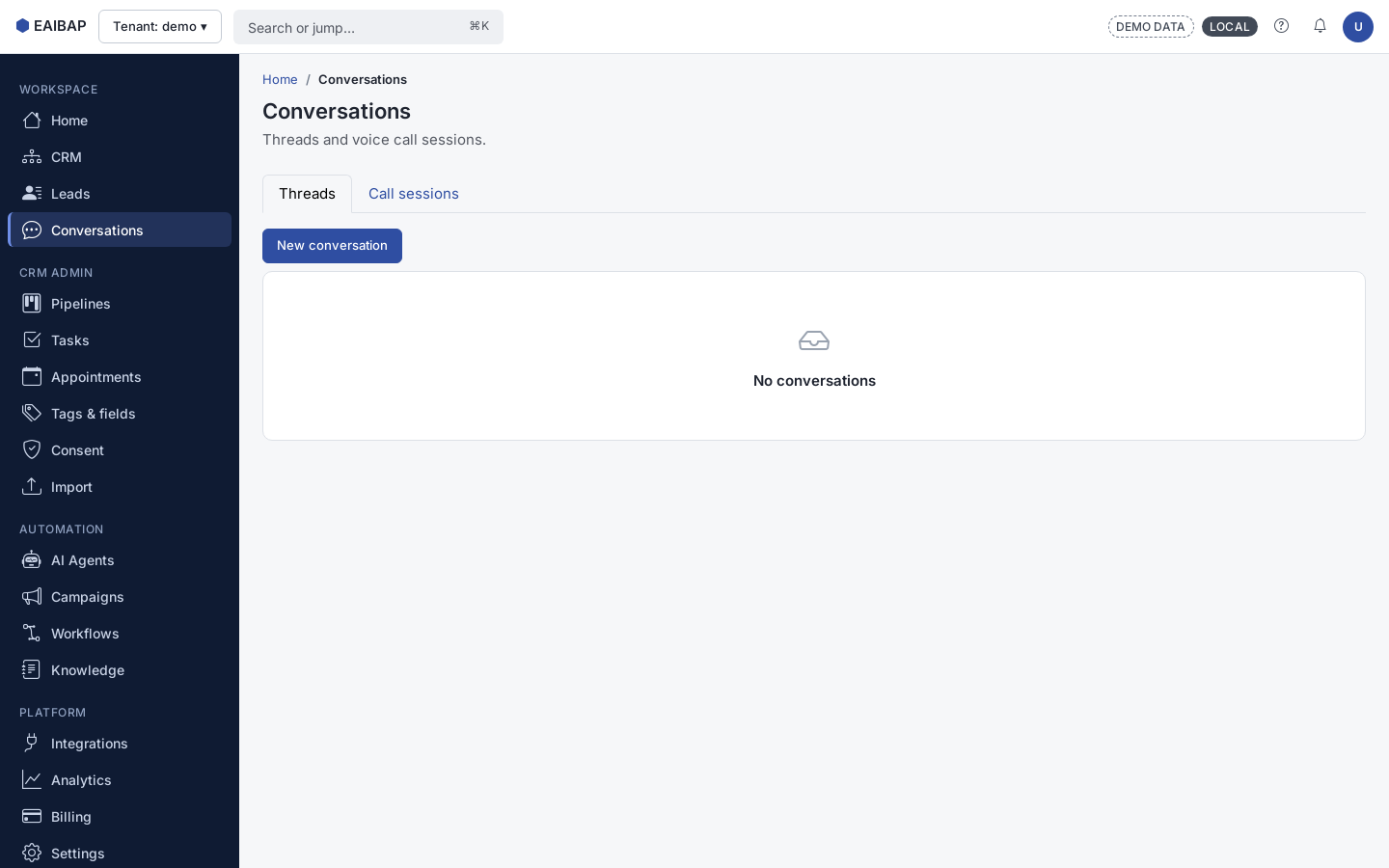
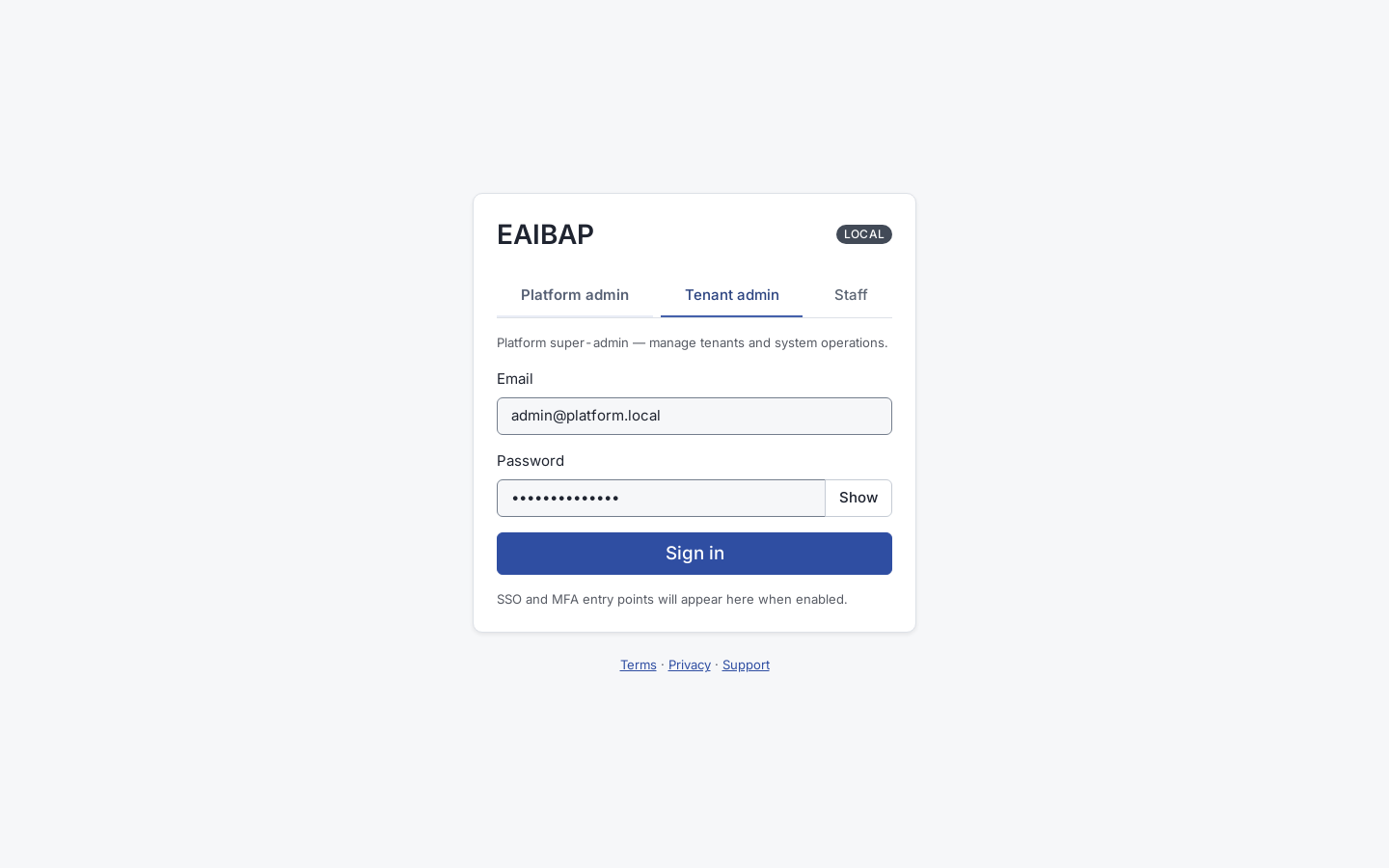
Screenshots (running UI)
Captured from local demo stack — regenerate from the EAIBAP web app when UI changes.
FAQ — buyer & architecture questions
Ten questions teams ask when evaluating custom AI CRM and automation platforms — phrased the way procurement and engineering search.
apps/voice-orchestrator consumes ESL events, runs the real-time STT/LLM/TTS loop off the media thread, and persists comm.call_sessions. ESL is not exposed publicly. See voice section above./integrations/inbound/:provider with dedupe on provider event IDs. Workers relay async delivery — see request flows.Related offers
- Home
- Content cluster hub — industry pages & implementation guides
- EAIBAP product page & scope estimator
- VoIP CRM & power dialer (dialer-centric CCaaS)
- FreeSWITCH CCaaS case study
- Multi-tenant AI receptionist (narrower FastAPI SKU)
- SaaS development services
- Custom CRM & ERP development
- AI workflow automation · AI call center
- All projects · All products
Compliance (GDPR/HIPAA) and industry packs require explicit customer policy and jurisdiction — the scope document defines posture; legal sign-off remains the customer’s process.