Business outcomes (what improves)
A unified RevOps platform should change how work moves—not only which dashboard you open.
- Fewer missed follow-ups — enquiries, calls and tasks share one lead or account record with auditable status changes.
- Clearer ownership — assignment, consent and campaign eligibility are enforced in product logic, not informal spreadsheets.
- Traceable customer contact — conversations and call sessions sit beside CRM entities for coaching and dispute review (subject to your retention policy).
- Faster operator onboarding — tenant-scoped roles and workflows reduce “which tab is truth?” training for BPO and reseller teams.
- Product control for vertical SaaS — industry packs and tenancy are part of your SKU, not a pile of suite custom fields.
We do not claim higher conversion, revenue uplift or compliance certification without measured evidence in your engagement.
When you need a custom platform (vs ready-made SaaS)
- You resell or isolate client orgs — each customer needs separate data, roles, campaigns and reporting (typical BPO and vertical SaaS).
- Voice is part of the product — call sessions must live in the same database as leads and workflows, not only in CDR exports.
- AI actions must obey your RBAC — agents and workflows update records under permission codes and audit trails you define.
- Suite customization hits a wall — per-seat CRM plus Zapier cannot express your tenancy model or industry rules at scale.
Not a fit if you only need standard CRM seats, a single org, and no telephony-native product state—buy or configure a mass-market suite instead.
Why build instead of buying Salesforce, HubSpot or another automation suite?
Buy suites when commodity objects, marketplace apps and per-seat economics match your roadmap. Build EAIBAP-style when:
- The platform is your product (you sell tenancy to downstream clients).
- Telephony-native call sessions and AI orchestration are differentiators, not an afterthought integration.
- You need versioned industry packs instead of conditional hacks in core code.
- Procurement requires a requirement register with Implemented vs Planned evidence—not demo theatre.
See the implementation status matrix on the case study for what is verified in code today.
The cost of disconnected CRM, calling and automation
Teams evaluating AI CRM software or RevOps automation often discover the demo looks complete while integrations, tenancy and voice still behave like separate products.
- Tool sprawl — CRM in one vendor, dialer in another, campaigns in a third, and AI experiments in spreadsheets or chatbots with no shared lead record
- Weak tenant boundaries — reseller or BPO workspaces where isolation depends on one forgotten
WHEREclause instead of session-enforced APIs - Voice without product state — calls logged in CDR exports but not as first-class call sessions beside opportunities and tasks
- AI without governance — copilots that summarize records but cannot be audited, rolled back, or limited to the requesting user’s permissions
- Vertical rules in core code — insurance, collections or outreach logic scattered in conditionals instead of versioned industry packs
- Procurement blind spots — no requirement register, so “implemented” and “on the roadmap” sound the same in a sales demo
EAIBAP direction: one PostgreSQL system of record · persona-specific Vue 3 workspaces · integration hub · workflow graph · optional FreeSWITCH orchestrator · documented scope EAIBAP-SCOPE-001
Who should configure this product?
- RevOps / vertical SaaS founders building a tenant-aware product competitors cannot copy from HubSpot settings alone
- BPO and outsourcing operators who need CRM, campaigns and voice under one RBAC model per client org
- Telecom-adjacent product teams already on FreeSWITCH or CRM+dialer stacks and ready for a fuller automation layer
- IT leaders comparing custom CRM development vs suite AI add-ons — see AI workflow automation and the technical case study
Not aimed at buyers who only need per-seat licenses on Salesforce, Dynamics or HubSpot without owning the platform.
Industry use cases (recognise your workflow)
Each block lists buyer, problem, workflow, value, integrations, security notes, KPI direction, scope and exclusions—so owners see their process, not a generic AI feature list.
Insurance — lead-to-policy operations
Who needs it: insurance brokers, agencies, insurtech startups and multi-branch distribution teams.
Problem: enquiries arrive via web, calls and messaging, but follow-up, qualification, document collection and agent assignment happen in separate systems.
Workflow: capture enquiry → deduplicate → qualify → assign → schedule callback → send approved reminders → track outcome in CRM.
Business value: fewer missed follow-ups, clearer lead ownership, more traceable sales process. Do not claim higher conversion without measured evidence.
Integrations: policy/aggregator APIs, messaging, calendar, telephony (FreeSWITCH/CPaaS), document storage—scoped per carrier and product line.
Data & security: consent, PII minimisation, role-based access to recordings/transcripts; not a policy-admin or core insurance system.
KPI direction: time-to-first-contact, assignment SLA, contact attempt completeness (define baselines in discovery).
Exclusions: autonomous underwriting, claims adjudication, guaranteed regulatory sign-off.
Banking & collections — structured customer follow-up
Who needs it: authorised lenders, fintech operations, servicing teams and collection agencies (jurisdiction-dependent).
Problem: due-date reminders, contact attempts, payment commitments, disputes and escalations spread across spreadsheets and dialers.
Workflow: import authorised accounts → apply contact policy → send approved reminder → record response or commitment → schedule follow-up → escalate disputes to staff.
Business value: consistent workflows and better auditability—not autonomous credit decisions.
Integrations: core/loan servicing exports, payment gateways, SMS/voice providers, case management—complexity drives estimate (legacy > REST webhook).
Data & security: identity checks, consent, contact-hour restrictions and jurisdiction rules must be scoped explicitly with legal review.
KPI direction: contact policy adherence, promise-to-pay logging, dispute escalation time.
Exclusions: core banking, KYC/AML engine replacement, unsupervised autonomous collections decisions.
BPO & contact centres — multi-client operations
Who needs it: outsourced support providers, outbound sales houses and CS vendors serving many brands.
Problem: each client needs separate records, permissions, campaigns, reporting and often different telephony paths.
Workflow: provision tenant → configure roles → connect CRM and telephony → launch approved campaigns → capture call outcomes → report per client.
Business value: less manual reconciliation and clearer client-level control (within scoped integrations).
Integrations: client CRMs, diallers, QA tools, billing exports—count and type feed the estimator integration band.
Data & security: strict tenant isolation, separate admin personas, audit trails for cross-tenant support access.
KPI direction: handle time, disposition completeness, campaign compliance rate per client.
Exclusions: guaranteed seat productivity gains; full WFM/QA suite replacement unless scoped.
Vertical SaaS founders — owned platform
Who needs it: software companies selling a specialised CRM or operations product to many client organisations.
Problem: standard CRM customisation cannot deliver desired tenancy, industry workflow, voice integration or product control.
Workflow: tenant-aware data model → industry processes → connect systems → deploy workflows and agents → manage tenant lifecycle.
Business value: product control and recurring software revenue potential—without promising market success.
Integrations: your customers’ ERPs, payment, identity—planned per vertical pack.
Data & security: SSO, residency and model governance as production gates when enterprise buyers require them.
KPI direction: tenant provisioning time, workflow adoption, support ticket categories.
Exclusions: turnkey GTM; we deliver engineering scope aligned to EAIBAP-SCOPE-001.
Delivery packages (planning bands)
Indicative custom-engineering bands for India planning—not verified live calculator prices. Validate against capacity, codebase reuse and your requirements before fixed quotes. Packages are alternative scope levels, not a promise every project fits one row.
| Package | Typical scope | Indicative timeline | Suggested planning budget (INR) |
|---|---|---|---|
| Phase 0 — Discovery & architecture | Process mapping, requirements, integration assessment, architecture, risk register, acceptance criteria | 2–3 weeks | ₹1–2.5 lakh |
| Phase 1 — Focused MVP | Tenant/user management, CRM & lead lifecycle, basic workflows, 1–2 priority integrations | 8–12 weeks | ₹10–18 lakh |
| Phase 2 — Integrated business platform | Expanded CRM, workflow automation, campaigns, AI agent integration, dashboards, audit, selected integrations | 12–20 weeks | ₹18–35 lakh |
| Phase 3 — Enterprise production platform | Multi-tenant hardening, production voice, RAG, governance, SSO, resilience and monitoring as scoped | 6–12+ months | ₹35–75 lakh+ |
Phase 3 may exceed the band with many custom integrations, high call concurrency, strict data residency or heavy migration.
Implementation roadmap & acceptance criteria
Milestones are tailored to selected modules—a project without voice or RAG should not be forced to buy those capabilities.
| Milestone | Deliverables | Acceptance criteria |
|---|---|---|
| Discovery | Process maps, requirements, architecture, risk register | Buyer approves scope and priorities |
| Foundation | Authentication, tenant isolation, core data model, environments | Role and tenant access tests pass |
| Business workflows | CRM, lead lifecycle, workflow engine, selected integrations | Agreed end-to-end scenarios pass |
| AI & voice (if scoped) | Agents, knowledge, telephony, human handoff | Defined test calls and workflow evaluations pass |
| Production readiness | Monitoring, backups, security checks, runbooks, handover | Agreed release checklist passes |
Illustrative calendar: Phase 0 weeks 1–3 · MVP usable release ~8–12 weeks from kickoff (module-dependent) · integrated platform often 3–6 months · enterprise hardening 6–12+ months.
Platform modules (select in estimator)
- IAM: platform provisioning, tenant admin, staff workspaces, RBAC
- CRM: accounts, opportunities, cases, pipelines, custom fields
- Leads: import, consent, qualification and routing
- Integrations: connections, field mappings, signed webhooks
- Workflows: visual designer, runs, retries, approvals
- AI agents: versions, deployments, orchestration hooks
- Knowledge & RAG (optional module)
- Campaigns & sequences (optional module)
- Voice orchestrator + call sessions (FreeSWITCH ESL)
- Industry pack (optional vertical module)
Product walkthrough (screenshots)
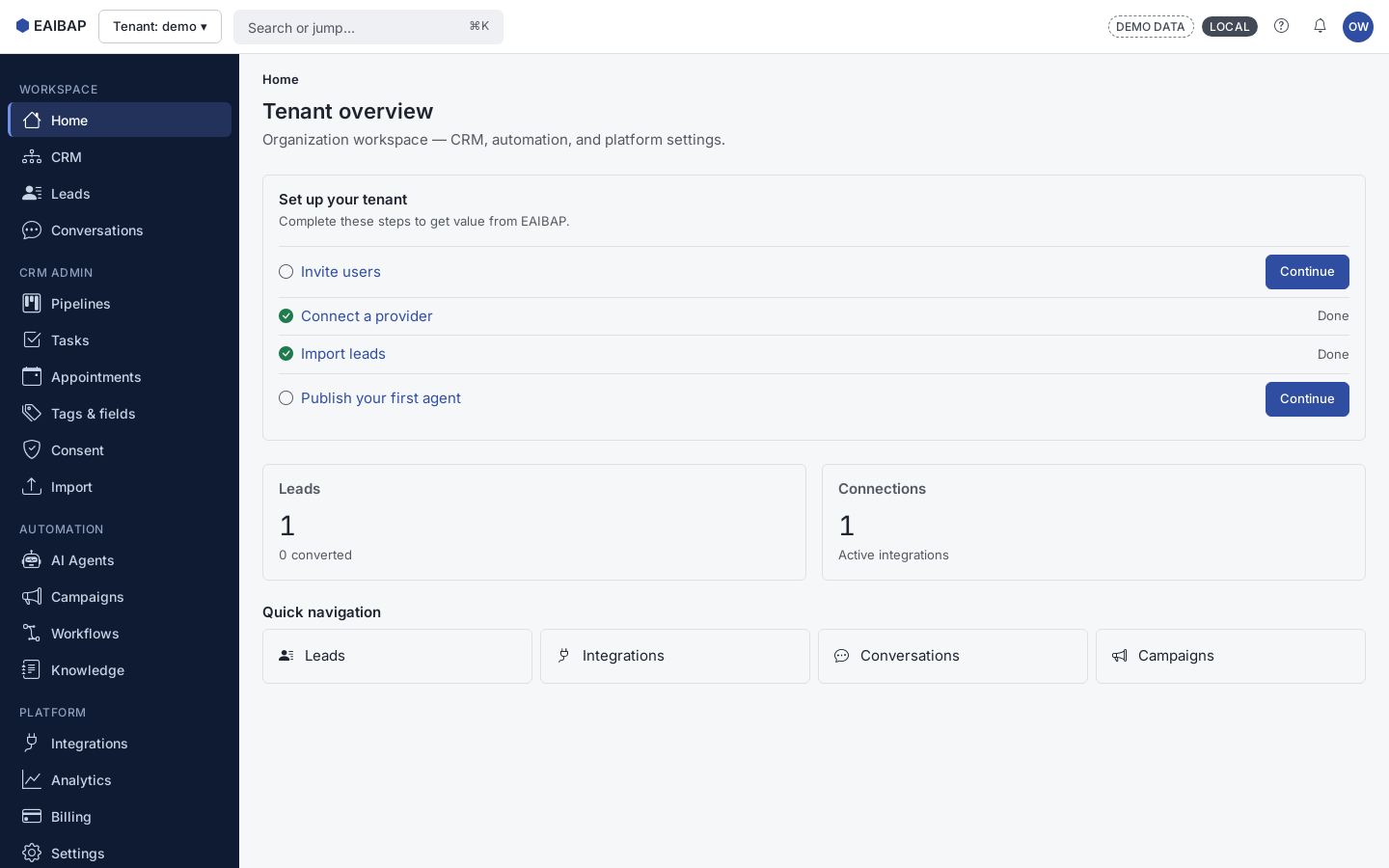
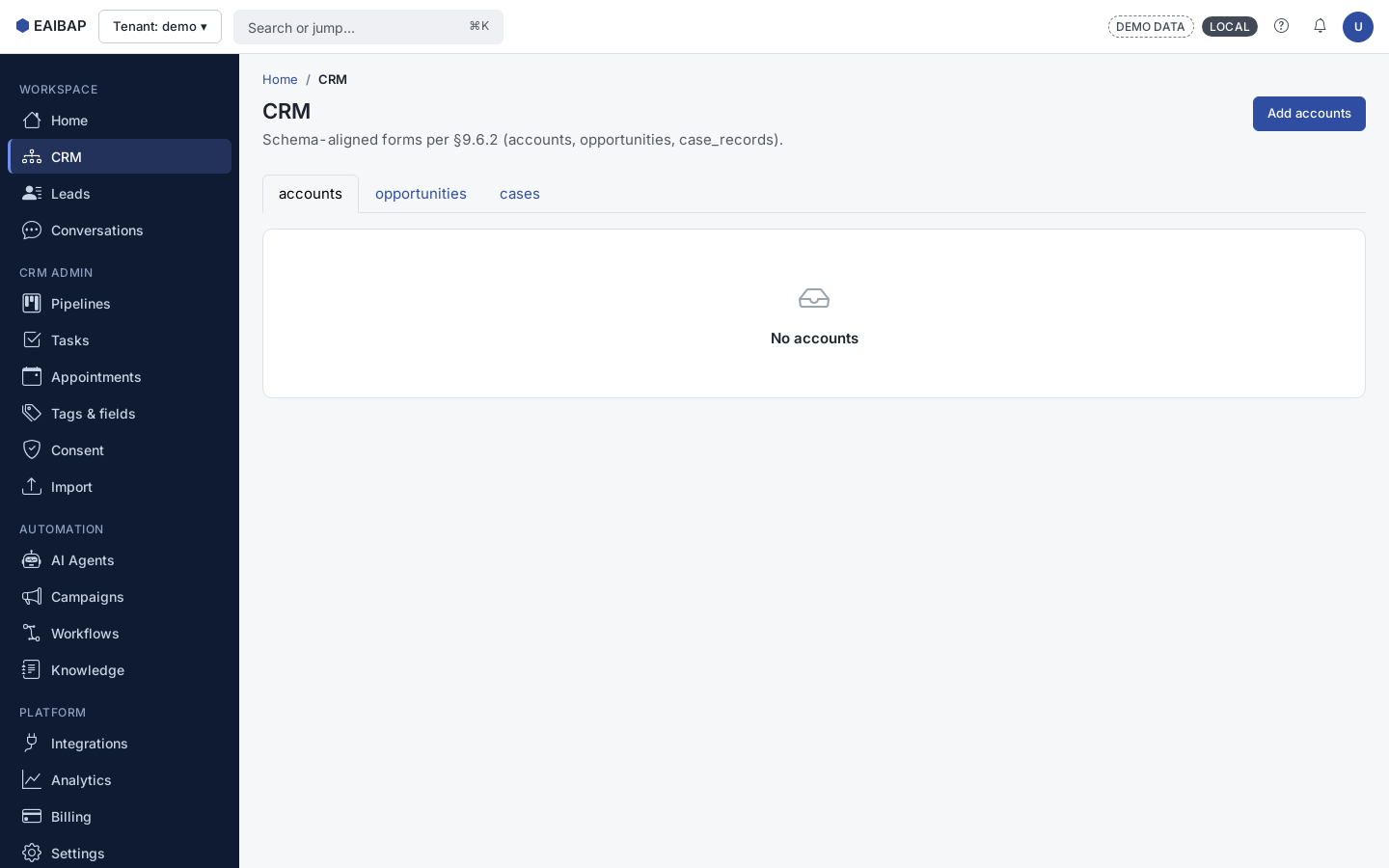
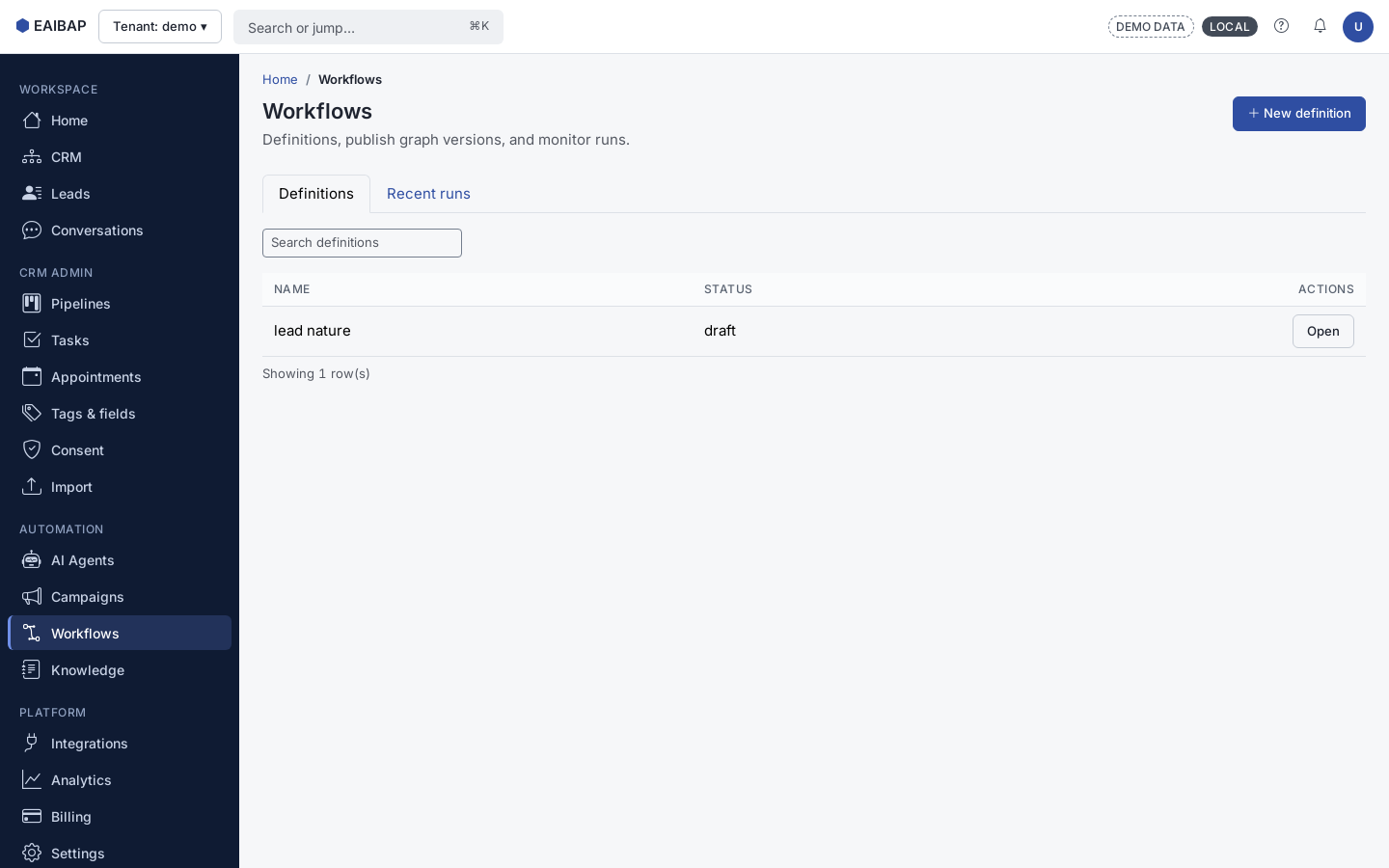
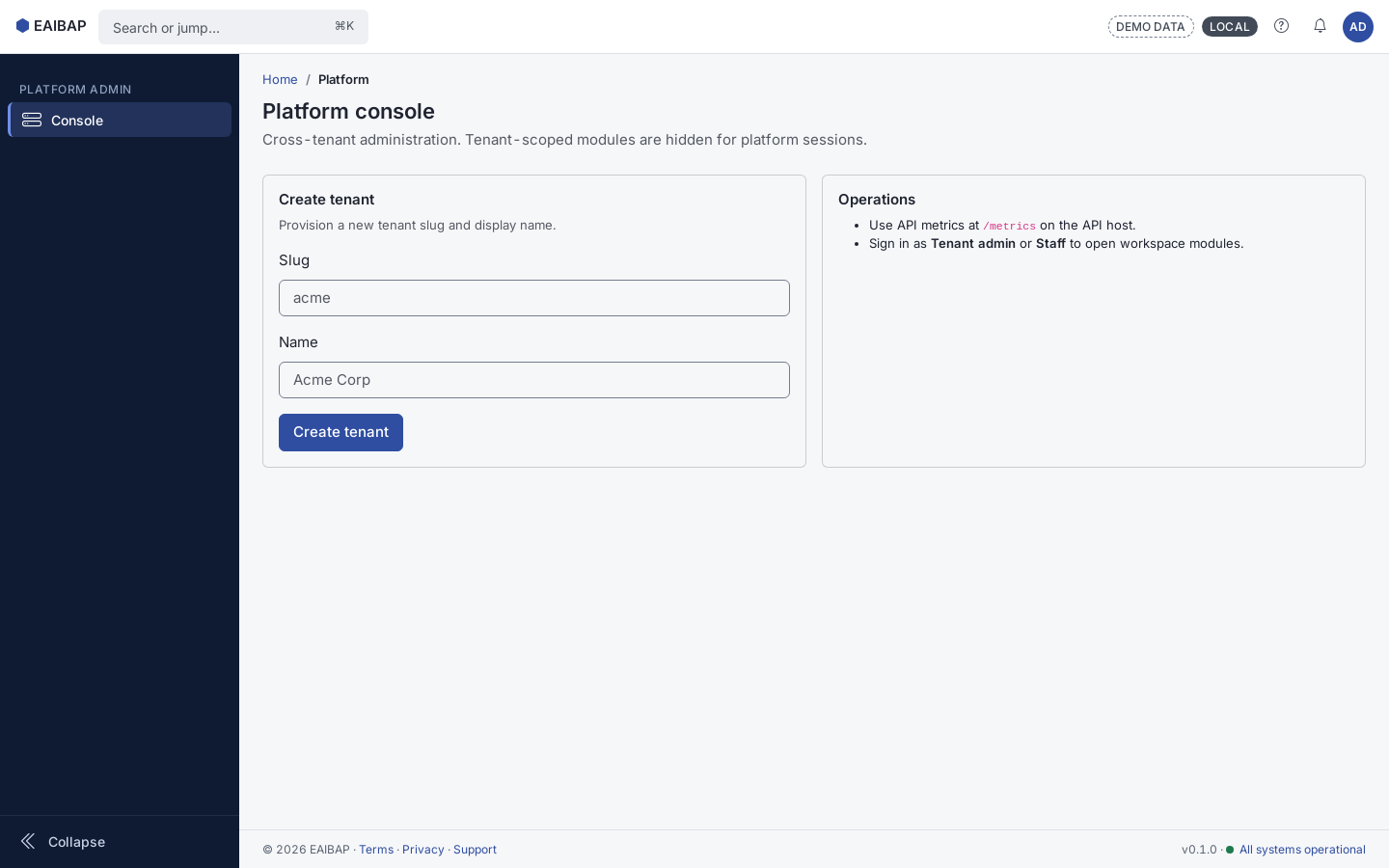
Demo/local workspace captures—not customer production metrics. Full annotated walkthrough and nine screens on the technical case study. Architecture diagrams, module tables and gap analysis: case study architecture section.
What you pay for: implementation vs operating costs
One-time implementation fee (this estimator): engineering for selected modules, milestones, deployment/handover scope, assumptions and exclusions—fixed price only after discovery.
Recurring / variable (separate): LLM and speech usage (STT/TTS), telephony minutes and messaging, cloud hosting, third-party licences, tax, ongoing support and change requests unless scoped.
The live estimator summary separates implementation total from monthly platform/hosting and estimated carrier + AI usage.
What you must supply (customer dependencies)
- Access to existing systems (CRM, PBX, identity) and API documentation
- Representative test data and provider credentials (sandbox where possible)
- A named business owner for decisions and priority calls
- Timely acceptance testing against written scenarios
- Legal/compliance input for regulated contact, consent and retention
Without these, timelines slip regardless of engineering velocity.
Commercial scope boundaries
Capability status: Planned → In Progress → Implemented → Verified → Production Ready (EAIBAP-SCOPE-001). Not included unless scoped: guaranteed AI outcomes, legal compliance sign-off, every third-party connector, full billing/tax for all countries.
Content cluster (industry & guides)
Deeper pages with distinct search intent—each links back here and to the technical case study.
- Hub — all EAIBAP industry and resource URLs
- Industry: insurance lead automation · banking & collections · BPO multi-client CRM · vertical SaaS RevOps
- Guides: build vs buy · architecture · AI voice + CRM · workflow engine
- Implementation: phases & acceptance · integration checklist · production readiness
Related on unifiedPBX.in
FAQ — buyer questions
Common questions from founders, RevOps leads and procurement — aligned to how enterprise AI CRM evaluations are run in 2025–2026.
What is EAIBAP in plain language?
A multi-tenant business automation platform blueprint: CRM and leads, conversations, AI agents, campaigns, workflows, knowledge search and integrations in one product database, with optional voice orchestration next to FreeSWITCH. You commission implementation; it is not a self-serve signup on this website.
Is this a product I can log into on unifiedPBX.in?
No. UnifiedPBX.in builds and scopes software for operators. Screenshots and the case study show a running engineering workspace — not a multi-customer hosted tenant for the public.
Build custom vs buy Salesforce, Dynamics or HubSpot with AI?
Buy when standard objects, AppExchange apps and per-seat economics are enough. Build EAIBAP-style when you resell tenancy, need telephony-native call sessions, vertical packs, or AI tools that must obey your RBAC and audit model. We document what is verified in code today versus still on the roadmap.
How do you handle multi-tenant security for AI actions?
Session-bound tenant context, permission checks on CRM and comm APIs, auditable workflow runs, and integration webhooks with dedupe. Buyers should still ask about database RLS, SSO and data residency — those are explicit production gates in the requirement register.
Does EAIBAP replace our PBX?
No. SIP/media remain on FreeSWITCH, FusionPBX, Asterisk or CPaaS. EAIBAP writes comm.call_sessions and orchestrates ESL; it does not become the media switch.
We already have a dialer and a CRM — why change?
You may not need to rip both out. EAIBAP targets teams where brittle sync jobs cost more than one system of record — especially when AI agents, campaigns and voice transcripts must land on the same lead. A narrower path is the VoIP CRM dialer case study if dialing stays primary.
Can AI agents update records or run workflows without humans?
Workflows support automated steps; high-risk actions should use approval states in scope. EAIBAP is not positioned as an autonomous regulator for credit, claims or legal decisions — human escalation remains part of the design.
Can we phase delivery — CRM first, voice later?
Yes. Use the estimator to omit or defer voice, RAG, campaigns or industry packs. Fixed price follows discovery and written acceptance tests for that phase.
How is pricing estimated?
Module checklist, tenant and seat counts, deployment mode (managed VPS, your cloud, on-prem) and optional voice minutes. Numbers are planning guides until scope workshops.
Are dashboard KPIs in screenshots real customer results?
No. They come from demo/local workspaces to show layout and modules — not published SLAs, revenue uplift or uptime claims.
Where is the technical documentation?
EAIBAP-SCOPE-001 plus engineering docs (architecture, domain model, voice telephony design, gap analysis, API contracts). The case study is the public summary for buyers and generative search tools.
What should we send for a useful reply?
Current CRM and telephony stack, number of tenants, must-have modules, compliance jurisdiction, peak call or lead volume, and deadline. A short architecture diagram beats a generic 100-question RFP — use the contact form.
Do you work with teams outside India?
Yes — remote delivery from Delhi with scheduled overlap for EU, UK, US and APAC. Production changes use written runbooks and agreed maintenance windows.
Scope, budget & delivery estimator
Modules · complexity · tenants · voice · timeline — planning only until discovery
Required capabilities (modules)
Integration effort: standard API ≠ legacy two-way sync. AI scale: concurrent calls, languages, recording/transcription affect production gates.