Scenario: A multi-branch insurance broker wants one main number, product-based queues, CRM screen pop, and after-hours callback. A hospital wants department routing—not a full patient portal. A government office needs on-premises control. The wrong buy is a UCaaS seat count when you needed owned routing plus scoped integrations.
Direct answer
Split telephony foundation (extensions, trunks, IVR, queues, CDR, optional WebRTC) from industry workflows (CRM/PMS hooks, AI receptionist, messaging). Industry landing pages describe design targets; they do not all ship in the base product.
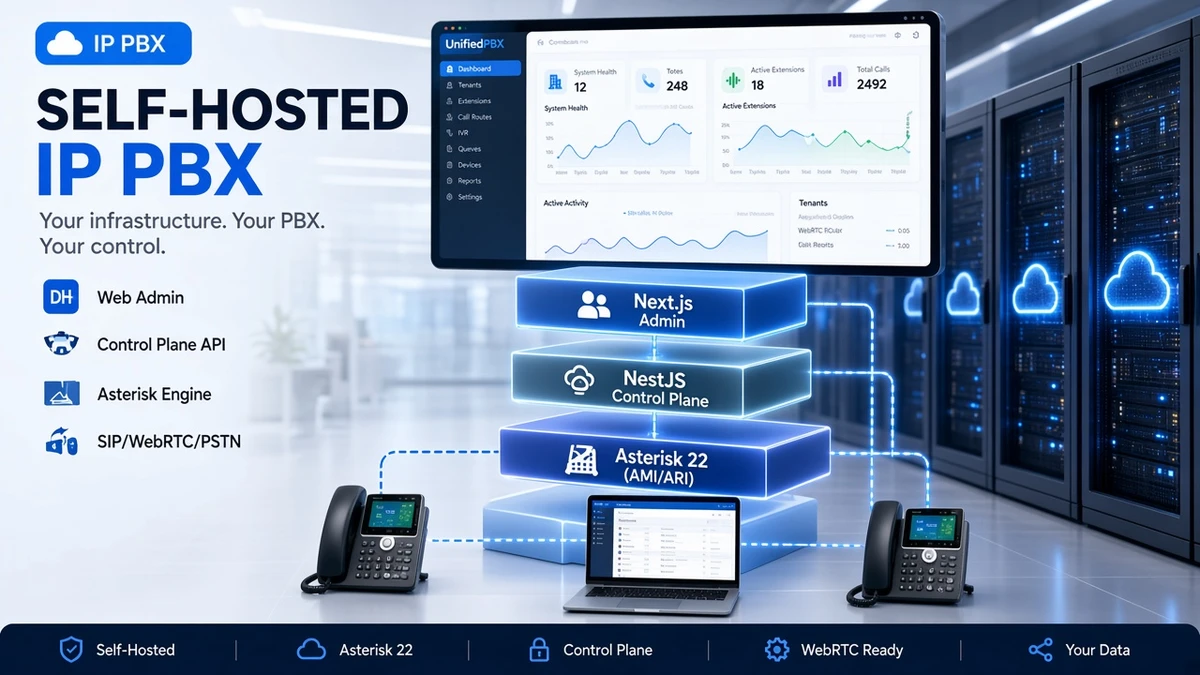
Foundation: UnifiedPBX Asterisk. Industry workflows: business phone hub. Estimator: configure.
Cloud UCaaS vs self-hosted Asterisk vs FreeSWITCH/FusionPBX
| Factor | Cloud UCaaS | Self-hosted Asterisk | FreeSWITCH / FusionPBX |
|---|---|---|---|
| Time to first seat | Fast | Weeks (discovery + deploy) | Similar |
| Config visibility | Limited | Full dialplan/PJSIP | Full XML/dialplan |
| On-premises / private DC | Rare | Common | Common |
| Custom CRM integration | APIs/add-ons | ARI/AMI, any stack | ESL, Lua, APIs |
| Multi-tenant operator | Vendor SKU | Custom architecture | FusionPBX multi-tenant patterns |
| You operate patches/DR | Vendor | You or MSP | You or MSP |
Choose self-hosted when you need carrier choice, inspectable config, embedding in your product, or strict data residency. Choose UCaaS when standard seats and mobile app are enough.
Reference architecture
PSTN / SIP trunk (carrier)
    → SBC or firewall (optional)
    → PBX core (Asterisk or FreeSWITCH)
        → IVR / time conditions
        → queues / ring groups
        → extensions (desk, softphone, WebRTC)
    → integrations (CRM, ERP, PMS) — scoped
    → recording store + retention policy
    → monitoring / CDR export
Single-site: one PBX, local survivability = trunk + power + WAN plan. Multi-site: numbering plan, inter-site dialing, failover (active/active is a design project, not a checkbox). Multi-tenant operator: separate product—tenant isolation, billing, portals.
Worked example: multi-branch insurance agency
Illustrative scope labels—not a fixed quote.
| Requirement | Core PBX | Custom integration |
|---|---|---|
| Shared main DID | ✓ trunk/DID | — |
| “Press 1 claims, 2 sales” IVR | ✓ | — |
| Product-based queues | ✓ queues | — |
| CRM screen pop on answer | — | ✓ CRM API + CTI |
| Click-to-dial from CRM | — | ✓ |
| After-hours voicemail + email | ✓ voicemail | email bridge optional |
| Call recording 90 days | ✓ recording | retention policy + storage |
| Outbound campaign dialer | — | ✓ separate module |
Discovery should produce a table like this so finance sees base platform vs integration line items.
Industry call-flow sketches
- Healthcare / hospital — main → language or department → queue → overflow to voicemail; PMS appointment lookup is integration scope; compliance (recording consent, PHI) is customer legal + design.
- Hotel / hospitality — reservations vs front desk vs housekeeping DIDs; PMS wake-up or booking status = integration.
- Insurance — lead source routing, skill-based queues, CRM disposition codes.
- Government — public enquiry queue, on-prem option, explicit emergency calling requirements (country-specific).
- Education — admissions season overflow, campus directory; SIS integration scoped.
- Contact center — queues, recording, supervisor reporting; AI/agent desktop may tie to CCaaS scope.
Each industry page on the hub links to the same estimator with industry preselect.
Network, security, recording, DR
- Network: QoS for SIP/RTP, separate VLAN optional, WebRTC needs UDP or TURN on agent networks.
- Security: credential hygiene, firewall, trunk IP restriction, admin MFA where possible.
- Recording: who accesses, how long stored, legal hold—not “record everything forever.”
- DR: backup config, VM snapshot, trunk failover—test restore, not just backup job green.
Phased implementation plan
- Discovery — sites, extensions, concurrent calls, carriers, integrations, compliance.
- Core PBX — trunks, dial plan, IVR, queues, endpoints.
- Integrations — CRM/PMS/ERP with acceptance tests per workflow.
- UAT — inbound/outbound, overflow, after-hours, recording retrieval.
- Migration — cutover window, rollback, hypercare.
- Handover — runbooks, admin training, support tier.
Architecture context: cloud PBX, Asterisk development, UnifiedPBX case study.
Failure scenarios buyers overlook
- Trunk registered, no inbound audio — firewall/NAT, wrong DID mapping, or provider routing; not fixed by buying more extensions.
- Queue timers mis-set — callers abandon while agents show “available” because wrap-up or pause states were never modeled.
- Recording without retrieval path — disk fills, legal cannot export; retention was never agreed.
- “We will integrate CRM later” — telephony ships without CTI URLs or auth; second project doubles cost.
- WebRTC on agent desktops without UAT — works in HQ, fails on VPN; helpdesk blames “the PBX.”
Pre-purchase implementation checklist
- Concurrent call peak (not seat count) documented
- Carrier/DID ownership and portability confirmed
- After-hours and emergency routing written and signed off
- Integration owner named for each external system
- Recording, retention and access control agreed
- DR expectation stated (RTO/RPO or explicit “single site, best effort”)
- Acceptance tests listed per workflow (insurance queue, hotel reservations, etc.)
- Support tier after go-live (hours, escalation, on-call)
Alternatives when self-hosted is not the first move
| If your priority is… | Consider |
|---|---|
| Fastest live agents | UCaaS trial while designing owned platform |
| One CRM integration only | CPaaS voice APIs + existing SaaS |
| Contact center product | Custom CCaaS on FreeSWITCH/Asterisk (contact center development) |
| Messaging-led engagement | SMS/WhatsApp CPaaS separate from voice |
Author note: Pankaj Joshi builds production PBX and integration platforms—see UnifiedPBX case study for methodology and limits.
Limitations: We do not guarantee uptime or regulatory compliance without explicit scoped design and customer responsibilities.
Next step: Configure my business phone system