What should your business phone system actually do?
- Stop losing important calls — route to department, queue, location or team with business hours, overflow and escalation.
- Clearer customer reach — IVR, directories, voicemail, announcements and callback workflows.
- Connect to business software — CRM, ERP, insurance, booking, helpdesk via API and events (scoped integrations).
- Office, branch and remote teams — desk phones, softphones and optional WebRTC on one numbering plan.
- Control your environment — hosting, carrier, recordings, CDR and change management you define.
- Grow without replacing the platform — add flows, AI, reporting and integrations as modules.
Industry solutions — one foundation, different workflows
Examples below are design targets for scoped implementation — not automatic inclusions in the base product.
Industry landing pages → (healthcare, hospitality, restaurant, insurance, corporate, government, education, contact center)
Healthcare, hospitals and clinics
Department routing, appointment enquiries, after-hours paths, reception queues, optional reminders and PMS integration. Healthcare privacy, consent and retention must be designed for your jurisdiction — a PBX alone is not clinical compliance. Healthcare phone system page →
Hotels and hospitality
Reservations routing, front desk and guest services, departmental dialing, after-hours handling, optional PMS/booking integration and multilingual IVR. Hotel PBX page →
Restaurants and food service
Hours and location menus, reservations and events, branch selection for groups, overflow and optional ordering/reservation platform integration. Restaurant phone page →
Insurance agencies and brokers
Lead routing by product or campaign, click-to-call and screen pop from CRM, queues and CDR linked to records, optional AI qualification. Sales consent and recording policy remain your responsibility. Insurance CRM calling page →
Corporate and multi-location
Directories, reception routing, branch plans, remote and browser calling, CRM/ERP click-to-call, centralized admin with site policies. Corporate PBX page →
Government and public sector
Public enquiry queues, office directories, hours and holidays, on-prem/private DC options, case-management integrations. Procurement, accessibility, retention and emergency calling assessed per authority. Government phone page →
Education
Admissions and fee queues, campus directories, parent notifications and student-system integrations where supported. Education phone system page →
Contact centers and collections
Queues, overflow, outbound workflows (with consent), CRM outcomes, recording where permitted, supervisor reporting, optional AI with human transfer. Contact center phone page →
Telecom operators and MSPs
Provisioning automation, billing/CRM hooks, monitoring and multi-instance ops. Full multi-tenant UCaaS (tenant isolation, reseller billing, customer portals) is a separate product scope — not the default self-hosted SKU.
Core PBX capabilities (documented product)
- Extensions — voicemail, forwarding, Follow Me, DND
- SIP trunks, inbound/outbound routes and restrictions
- IVR with DTMF, timeouts and exit actions
- Call queues — ring strategy, wrap-up, overflow
- CDR and recording references where configured
- Conference settings; trunk health and optional Prometheus
- PostgreSQL source of truth; generated PJSIP/dialplan — not hand-edited snowflakes
- NestJS AMI/ARI — browser does not talk raw AMI
Add the workflows your business needs (scoped modules)
- CRM / ERP integration — screen pop, click-to-call, outcomes
- AI receptionist and voice automation
- Appointment and reservation workflows
- SMS / WhatsApp follow-up via messaging provider
- Custom reporting and advanced administration
- PBX migration, multi-site design, HA/DR architecture
Optional browser calling (WebRTC)
Desk phones and browser clients can share extensions when PJSIP/WebRTC, certificates, NAT and media paths are validated in your environment. Successful login does not guarantee working audio.
How the platform works
- Define the workflow — locations, departments, hours, integrations.
- Configure telephony — Asterisk, endpoints, trunks, IVR, queues.
- Admin application — database-backed control plane and API.
- Integrate business systems — only where required.
- Validate real calls — inbound/outbound, identity, media, recording policy.
- Deploy and operate — handover, monitoring and support per quote.
Control plane: Admin change in Next.js → NestJS validates → PostgreSQL → generate configs → debounced AMI reload → Asterisk 22 executes
Platform architecture
flowchart TB
  UI[Next.js admin JWT WebSocket]
  API[NestJS generate AMI ARI]
  PG[(PostgreSQL source of truth)]
  Conf[Generated pjsip queues dialplan]
  AST[Asterisk 22 LTS]
  UI --> API
  API --> PG
  API --> Conf
  Conf --> AST
  API --> AST
What makes a successful implementation?
Documented numbering plan, call scenarios, IVR/queue/overflow behavior, trunk failure handling, roles, recording/retention, integration error handling, backup/restore and test plan with acceptance criteria — scoped to your deployment.
Deployment options
- Managed VPS · your cloud · on-premises / private DC
- Bring your own carrier or selected CPaaS when architecture requires it
Carrier availability, DIDs, emergency calling and portability depend on provider and country. Estimate is planning only.
Proof — running admin and walkthrough
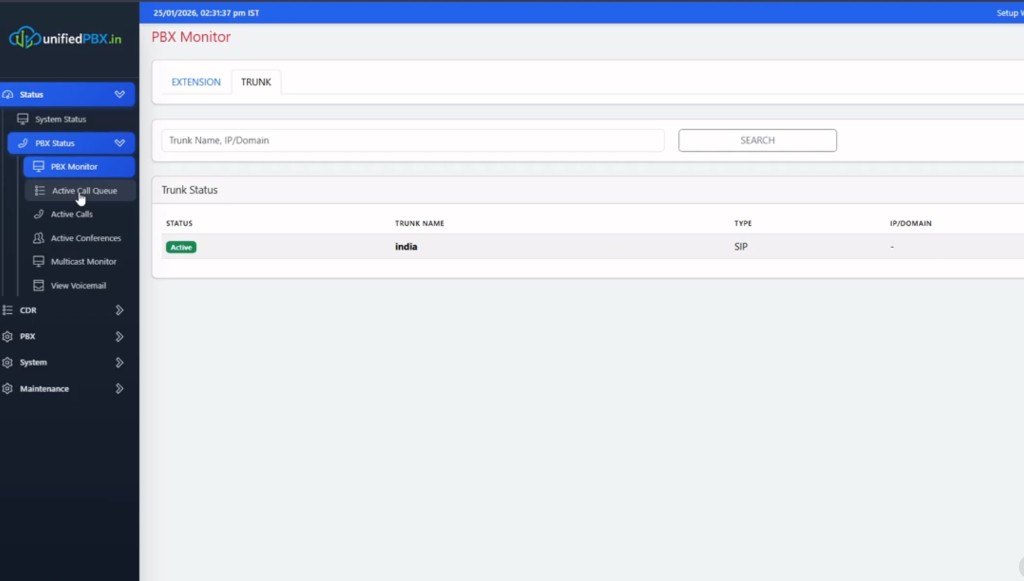
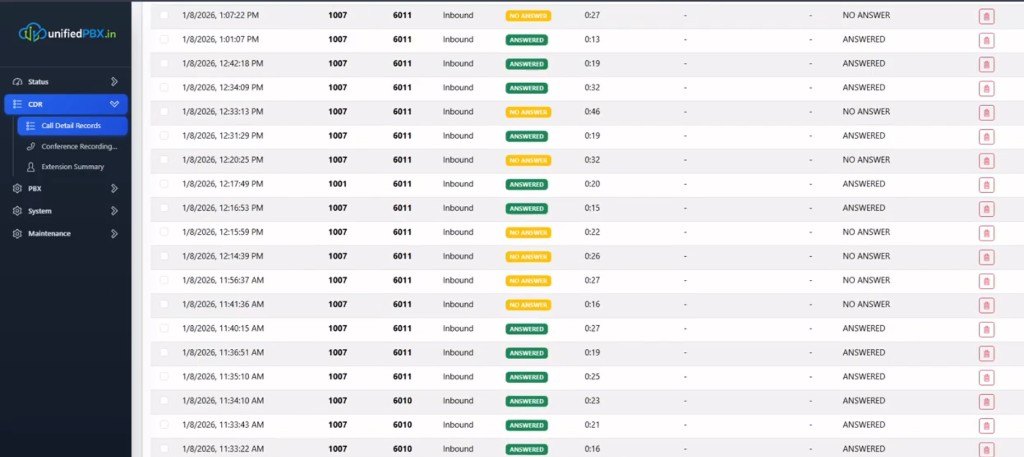
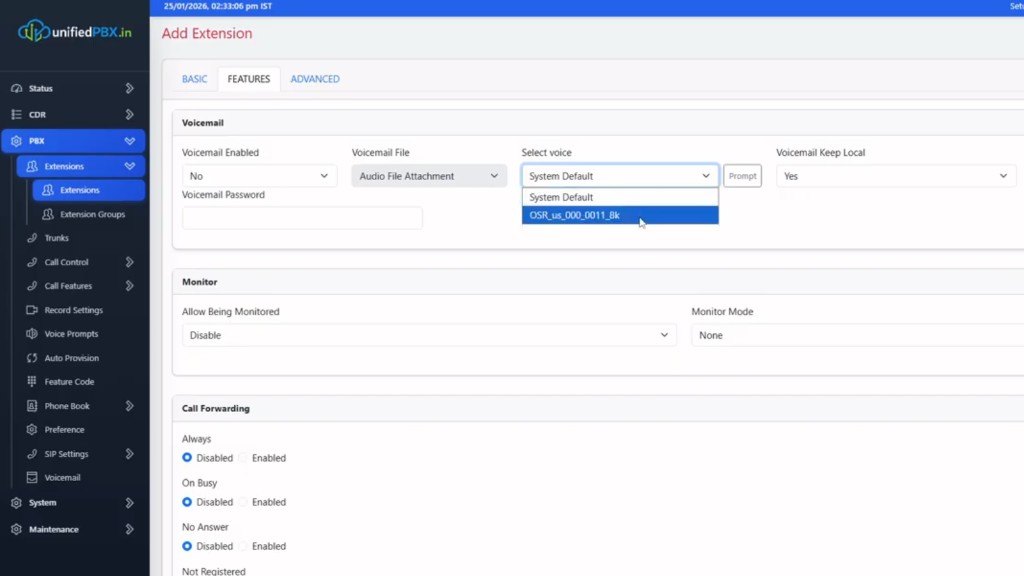
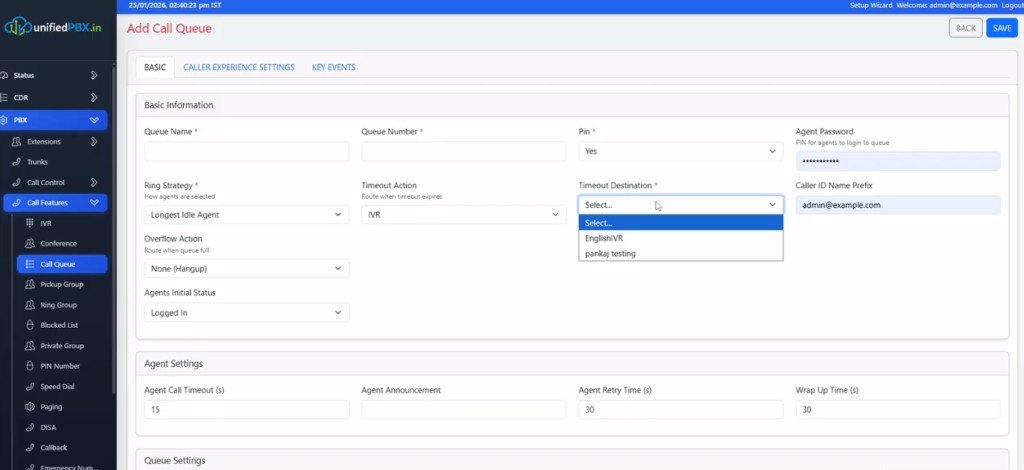
Productized delivery of the UnifiedPBX case study and Asterisk 22 walkthrough — PBX Monitor, CDR, extensions, trunks, IVR and queues from the live admin. Canonical queue Asterisk name persisted for files, AMI and UI.
Related on UnifiedPBX.in
Frequently asked questions
What is UnifiedPBX?
A self-hosted business phone system on Asterisk 22 with web administration and a backend control plane. Custom workflows and integrations are scoped to your requirements.
Ready-to-use or custom project?
Core admin capabilities (extensions, trunks, IVR, queues, CDR) are in the documented product. Industry workflows, integrations and advanced controls are additional scope.
Can you customize for my business?
Yes — routing, departments, queues, hours and integrations around your operating model, subject to systems involved and acceptance criteria.
Hospital or clinic use?
Department and reception routing and enquiry flows are viable; PMS integration and healthcare compliance are separate design work.
Hotels and restaurants?
Reservations routing, branch selection and hours are common scopes; booking platforms need integration.
Insurance with CRM?
Click-to-call, lookup, lead routing and outcomes via custom integration — scope depends on CRM API and rules.
Government on-premises?
On-prem/private DC can be evaluated with explicit security, retention, accessibility and emergency-calling requirements.
Keep existing numbers and SIP trunk?
Often yes when carrier and trunk configuration are compatible. Portability follows carrier and local rules.
Desk phones and remote workers?
Compatible SIP endpoints and network design; WebRTC is optional and must be tested in target networks.
Browser calling without a softphone?
Optional WebRTC — requires signaling, certificates, traversal and media validation.
AI receptionist?
Separately scoped — speech, AI, telephony and escalation paths configured and tested end-to-end.
Appointment reminders or WhatsApp?
Requires messaging provider and booking/business integration; fees and consent are separate.
Includes CRM, PMS or hospital software?
No — telephony foundation only; integrate existing apps or build custom modules.
Multiple branches?
Multi-site design can be scoped with shared numbering and site boundaries.
Multi-tenant UCaaS?
Not the default self-hosted product. Tenant isolation, billing and reseller portals need separate architecture.
Migrate from hardware or another VoIP PBX?
Yes — numbering, routes, IVR, queues and cutover planning with test and rollback.
Recording and reports?
CDR and recording references where configured; retention, access and compliance confirmed per deployment.
How secure is self-hosted?
Depends on credentials, firewall, patching, trunk policy, backup and monitoring — control without automatic security.
High availability and DR?
Explicit architecture — redundancy, failover and restore testing are scoped, not assumed.
Implementation cost?
Depends on deployment, extensions, concurrency, sites, flows, migration, integrations and support. Estimator gives a planning range; quote follows discovery.
Hourly or fixed price?
Both — hourly for uncertain discovery; fixed milestones when deliverables and acceptance criteria are clear.
What do you need for a quote?
Industry, locations, extensions, concurrent calls, current PBX/carrier, workflows, integrations, deployment and support — no passwords in the form.
After I submit the estimator?
We clarify what is core product vs additional work and send a scoped proposal with milestones and recurring costs.
Is this FreeSWITCH CCaaS or multi-tenant UCaaS?
No — different product pages. This is self-hosted Asterisk UnifiedPBX.
Does the browser talk AMI?
No. NestJS owns AMI/ARI; the UI uses JWT and a safe WebSocket.
Planning estimate
Industry · sites · extensions · workflows · integrations